
Journalist Recounts How Border Agents Targeted Him Over Coverage Of Ayatollah's Funeral
Grayzone journalist Max Blumenthal says US border agents told him he had no rights, as they took his electronics to invade his privacy and potentially compromise his sources
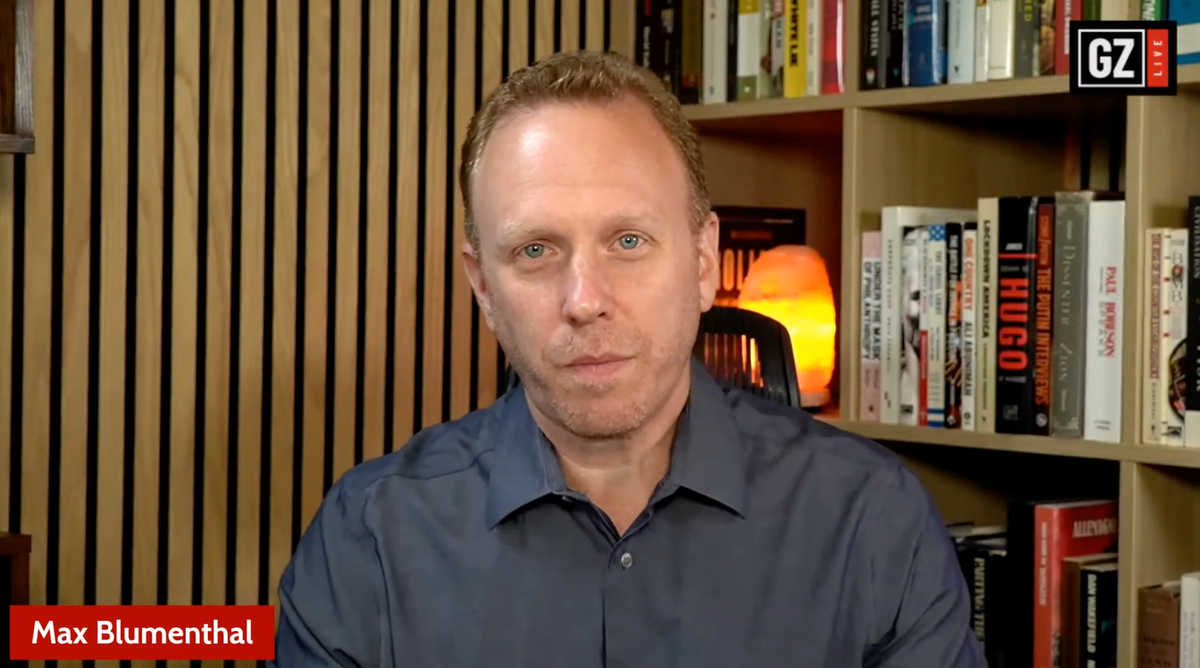
On July 10, United States border agents detained journalist Max Blumenthal at Dulles International Airport in Washington, D.C., and seized his electronic devices. He was returning from a trip to Iran to cover the funeral of Ayatollah Ali Khamenei.
“The seizure of my devices was a clear act of intimidation aimed at deterring me and others from doing further critical reporting from Iran, which is likely why my interrogators from [Customs and Border Protection] demanded to know if I would be returning to Tehran to report any time soon,” Blumenthal declared in a statement posted to the social media site formerly known as Twitter.
Condemning President Donald Trump’s administration, Blumenthal maintained that the “Israeli-influenced criminal cartel” was clearly threatened by the journalism that he did as editor-in-chief of The Grayzone.
“I showed the massive crowds of mourners and ferocious public backlash to the assassination of Khamenei, exposed US and Israeli war crimes against civilians from the ground, and conducted candid interviews with officials, negotiators and influential Iranians,” Blumenthal added.
Defending Rights and Dissent condemned the detention and interrogation, emphasizing that the civil liberties organization is opposed to such harassment at the U.S. border.
“Seizing and potentially searching a journalist’s electronic devices poses serious risk to press freedom. Journalists have not only a right, but a duty to report from countries under attack by the U.S. government and bring the U.S. people perspectives their government may not want them to hear,” Defending Rights and Dissent policy director Chip Gibbons stated.
The American-Arab Anti-Discrimination Committee (ADC) posted an advisory warning travelers of increased demands by border agents to search and seize electronics.
“The practice of seizing and searching a journalist’s phone or other electronic devices at the border raises grave First and Fourth amendment concerns,” ADC President and Legal Director, Jenin Younes, told The Grayzone. “Absent a legitimate and particularized national security justification, search of phones should not be a condition of entering the country.”
Younes continued, “The Supreme Court has recognized the important privacy interests in modern smart phones, an interest that is not diminished simply because an American is crossing the border. The search and seizure of Blumenthal’s phones is yet more concerning because it appears to be viewpoint based discrimination, given that prominent associates of the current administration have singled him out for condemnation because of his views.”
Upon arrival in Tehran, the Canary Mission targeted Blumenthal for political harassment. The outfit is used by Israeli intelligence to identify individuals who should be denied entry to Israel. It also blacklists U.S. students who engage in advocacy for Palestinians in an effort to make them unemployable after graduation.
Laura Loomer, a right-wing influencer with close ties to Trump, attacked Blumenthal as a “leading communist voice” who had traveled to “mourn” Khamenei. She later called on the FBI to launch a “heavily armed raid” against him at 5 a.m. and urged Secretary of State Marco Rubio to strip Blumenthal of his passport “for aiding the Iranian regime as they chant Death to America.” (Loomer has had a number of people in the Trump administration fired.)
Furthermore, Loomer hoped that Treasury Secretary Scott Bessent would investigate how he paid for his trip to Iran and find out if the Iranian government or Iranian Revolutionary Guard Corps had funded his trip in violation of U.S. sanctions.
Blumenthal pointed out during a Grayzone livestream on July 14 that the government previously raided his home on false pretenses. It happened on October 25, 2019, during Trump’s first term. He was targeted for his reporting on antiwar and international solidarity activists, who were in the Venezuela embassy in D.C. trying to defend it from supporters of Juan Guaido’s attempted coup.
He noticed that his boarding pass from Istanbul to D.C. was marked for secondary screening.
Upon arrival at Dulles, Blumenthal said his passport was taken by border agents and put in a red box. He was questioned at a metal table by two young officers “at the bottom of the food chain.” The officers kept referring to “instructions from their ‘managers,’” Blumenthal recalled. They asked him if he was “paid to conduct interviews in Iran,” which he thought was ridiculous.
“[Like] I’m going to go 20 hours on an economy flight, and then go into an area which could potentially become a war zone in order to collect money to conduct interviews. Like I can’t make money as a journalist in the U.S. and that’s what I have to do.”
Both officers wanted to know if Blumenthal felt threatened in Iran. “Did anything make you feel threatened? I said no, and then they asked again.”
“The questioning was basically useless and absurd and they demanded I open my devices. I open my phones. And I said no, I’m not going to give you my pass codes. So they detained my phones.”
“My phones were taken. And they told me we’re going to hook them up to machines and this should be done in a day. Well, it’s been several days,” Blumenthal added.
Blumenthal presumed that they meant that CBP would use Israeli Cellebrite technology to bypass the pass codes on his electronics and invade his privacy to “learn more about my sources and methods, to violate my Fourth Amendment rights, and to violate my First Amendment rights."
"And they told me you have no rights here. They said that to me, and that is well known.”
As the libertarian magazine Reason reported on July 13, a January 2026 policy directive states that border agents may search "any device that may contain information in an electronic or digital form, such as computers, tablets, disks, drives, tapes, flash drives, SIM cards, global positioning systems, unmanned aircraft systems, vehicle infotainment systems, smart watches, mobile phones and other communication devices, cameras, music and other media players."
“If you're entering the country, exiting the country, or within 100 miles of a border, it's fair game,” wrote Reason senior editor Elizabeth Nolan Brown. “In fiscal year 2025, CBP conducted 55,318 border searches of electronic devices. Most of these searches involved noncitizens, but 13,590 of them involved U.S. citizens.”
Warrantless searches of electronics by border agents have grown exponentially since 2015, and the Trump administration can easily take advantage of what is referred to as the “border search exception” to target journalists.
In 2018, the Committee to Protect Journalists (CPJ) published a report that “identified 37 journalists who said they found the secondary screenings invasive, 20 of whom reported that their electronic devices were searched. The cases included repeated secondary screenings, warrantless searches of electronic devices, and denial of entry.”
"I’m working on trying to recover those phones, but this was a complete violation of privacy. It was political targeting, political harassment because other reporters who were there, American reporters, have not been subjected to this treatment,” Blumenthal emphasized.
He mentioned that he was in Iran on “a press visa, the same press visa that was granted to reporters like NBC’s Richard Engel or CNN’s Frederik Pleitgen, who I joined at a press conference last Wednesday at the Iranian foreign ministry.” They were not apparently questioned and did not have their electronics searched upon return to the United States.
“Blumenthal was potentially singled out due to the content of his reporting, which has been highly critical of U.S. foreign policy, or due to an extended campaign against him led by pro-Israel McCarthyites,” Gibbons noted. “This is unacceptable and must be condemned in the strongest personal terms.”
In October 2024, Grayzone reporter Jeremy Loffredo was detained and barred from leaving Israel after he reported on impact sites where Iranian missiles had landed. However, he was ultimately released because an Israeli judge was presented with evidence that an Israeli reporter had published an article on Loffredo’s detention that contained the Grayzone report on damage from Iranian missiles.
The State Department was conspicuously silent as the Israeli government held a U.S. citizen in detention for committing an act of journalism.
Comments ()