
Revisiting 'Zero Dark Thirty,' A Definitive Example Of 9/11 Cinema
A highly influential faction of current and former CIA officers at war with the truth successfully injected their propaganda into a definitive Hollywood movie
[Editor's Note: The following is the final article in a series on "9/11 Cinema" that for the past two months took me away from publishing regular posts at The Dissenter. Since the story behind "Zero Dark Thirty" has some significant overlap with what I tend to cover here, I'm sharing it with paid subscribers. —Kevin Gosztola]
The vast majority of film critics in the United States hailed Kathryn Bigelow’s “Zero Dark Thirty” as a cinematic achievement. Most were enthralled by what they viewed as its procedural and “apolitical” nature.
“This is movie journalism that snaps and stings, that purifies a decade’s clamor and clutter into narrative clarity, with a salutary kick,” praised Richard Corliss of TIME Magazine.
Todd McCarthy of the Hollywood Reporter wrote, “Whether you call it well-informed speculative history, docudrama re-creation or very stripped-down suspense filmmaking, Zero Dark Thirty matches form and content to pretty terrific ends.”
“Once in a long while, a fresh-from-the-headlines movie—like ‘All the President’s Men’ or ‘United 93’—fuses journalism, procedural high drama, and the oxygenated atmosphere of a thriller into a new version of history written with lightning,” raved Owen Gleiberman of Entertainment Weekly.
Yet as critic after critic gushed over “Zero Dark Thirty,” journalists scrutinized the CIA’s role in the production. They also brought attention to the way in which it suggested “enhanced interrogation techniques,” or torture, was key to finding bin Laden. It quickly became one of the most hotly debated movies of the 21st century—and before the movie even opened in theaters.
Meanwhile, inside the U.S. government, the CIA was engaged in a concerted campaign to undermine the Senate intelligence committee as it investigated the agency’s rendition, detention, and torture program. Ageny officials granted Bigelow and screenwriter Mark Boal “exclusive access to the CIA version of history.”
”It makes sense to get behind the winning horse. Mark and Kathryn’s movie is going to be the first and the biggest. It’s got the most money behind it, and two Oscar winners on board,” one CIA document stated.
Aware of the filmmakers’ collaboration with the CIA, Senator Dianne Feinstein, the chair of the committee, and Senators John McCain and Carl Levin wrote a letter demanding that Sony Pictures add a disclaimer.
“We understand that the film is fiction, but it opens with the words ‘based on first-hand accounts of actual events’ and there has been significant media coverage of the CIA’s cooperation with the screenwriters,” the senators declared. “As you know, the film graphically depicts CIA officers repeatedly torturing detainees and then credits these detainees with providing critical lead information on the courier that led to Osama bin Laden.”
“Regardless of what message the filmmakers intended to convey, the movie clearly implies that the CIA’s coercive interrogation techniques were effective in eliciting important information related to a courier for Osama bin Laden. We have reviewed CIA records and know that this is incorrect.”
“[W]e believe that you have an obligation to state that the role of torture in the hunt for Osama bin Laden is not based on the facts, but rather part of the film’s fictional narrative,” the senators concluded.
Acting CIA Director Mike Morell agreed with the senators. “The film creates the strong impression that the enhanced interrogation techniques that were part of our former detention and interrogation program were the key to finding Bin Laden. That impression is false.”
Nevertheless, “Zero Dark Thirty” grossed $95 million domestically, three times as much as it made worldwide. It won two Oscars for “Best Film Editing” and “Best Sound Editing,” and it was nominated for “Best Actress, “Best Screenplay,” and “Best Picture.”
A highly influential faction of current and former CIA officers at war with the truth successfully injected their propaganda into a definitive Hollywood movie that would forever influence how millions of Americans understood the agency’s post-9/11 operations.
A Sobering Portrayal Of CIA Torture
The film’s opening immediately establishes its docudrama feel as we hear 911 emergency calls from people who were on hijacked planes or trapped in the World Trade Center when the towers collapsed. “Well, there’s no one here yet, and the floor is completely engulfed. We’re on the floor, and we can’t breathe,” and, “Please God, it’s so hot. I’m burnin’ up,” one woman cries.
All we see is a black screen. Bigelow and Boal understood that it was unnecessary to show the planes crashing or the towers falling. Those who lived through the day could recall the nightmare through their mind’s eye. But it also amplifies the film’s emotional manipulation of the audience, since the next 20 minutes involves scenes of CIA interrogators torturing detainees allegedly involved or linked to the “Saudi group”
The CIA’s man in Islamabad, Dan (Jason Clarke), ties up Ammar by his arms after beating him. Dan is flanked by two interrogators in balaclavas.“If you don’t look at me when I talk to you, I hurt you. If you step off this mat, I hurt you. If you lie to me, I’m gonna hurt you.” (The shooting script describes Dan as “a paramilitary hipster, a punk rocker with a Glock,” which may be one of the dopiest character descriptions I’ve ever read.)
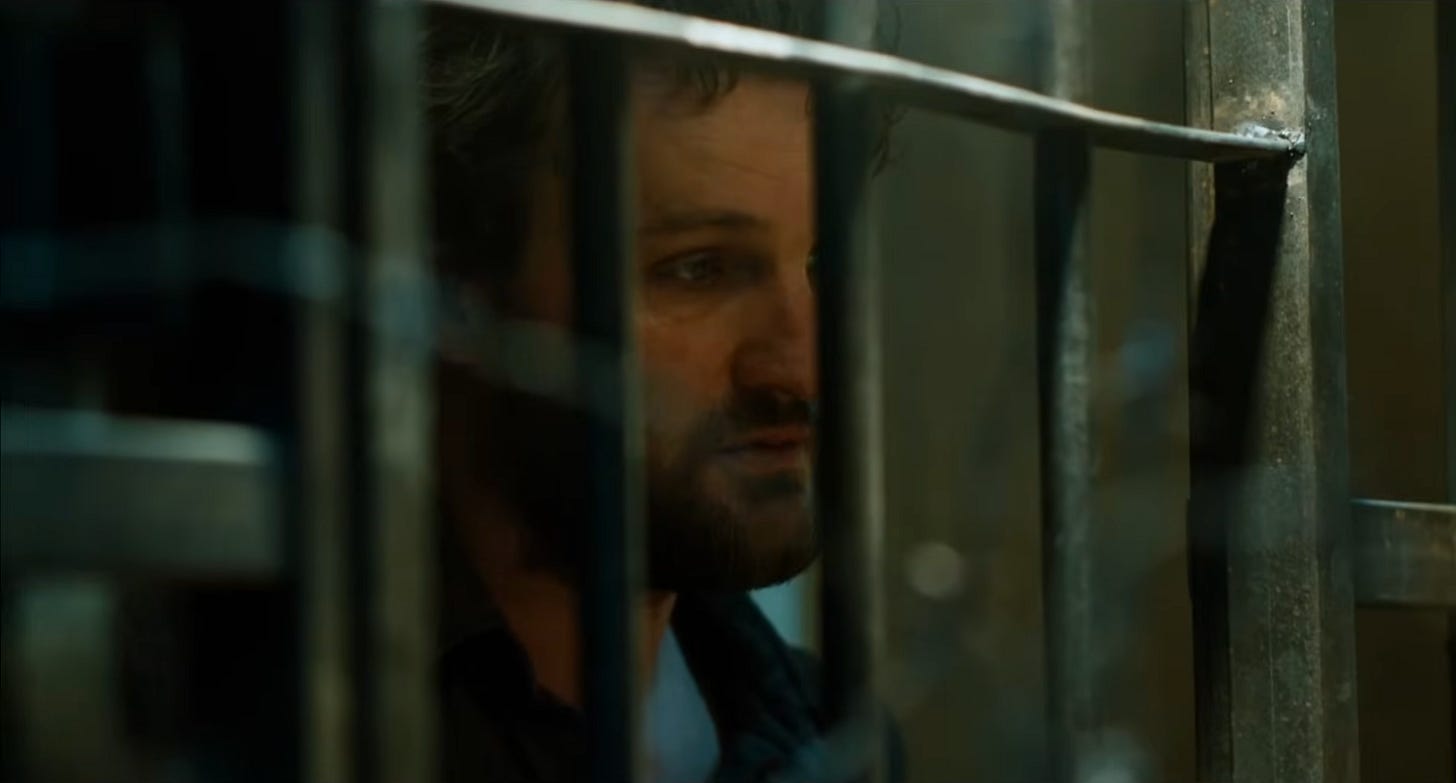
All three leave Ammar in isolation. One of the interrogators removes their mask, revealing that to the audience that they are Maya (Jessica Chastain). Dan informs her that it is going to take a while to get useful information from Ammar. “He has to learn how helpless he is,” an opaque reference to the torture techniques that were developed by CIA contract psychologists to inflict “learned helplessness.”
Maya insists on going back in to continue the interrogation, and this time she won’t wear a mask. Dan demands that Ammar provide a Saudi email for Hazem al-Kashmiri. He offers Ammar a blanket and solid food, however, Ammar says he will not talk to Dan and then that he does not know al-Kashmiri.
The scene is one of the most profoundly disturbing scenes in the film. Dan, Maya, and the third interrogator tackle Ammar and shove a wet cloth on his face. Boal’s script says, “Daniel pours water over the towel so it hits Ammar’s nose.” This is waterboarding, and indeed, as the script notes, Ammar nearly drowns. “When was the last time you saw bin Laden?” Dan bellows. It’s repeated like a catch phrase or tagline for the movie. “In the end, everybody breaks bro. It’s biology.”
At the U.S. Embassy in Islamabad, Dan introduces Maya to the CIA’s Pakistan station chief Joseph Bradley (Kyle Chandler). He also makes it clear that his team will have to “turn up the heat” on Ammar. “You don’t think [Maya’s] a little young for the hard stuff?” Bradley asks. “Washington says she’s a killer.” Moments later, Maya rejects a “bullshit” tip from a farmer who says he saw bin Laden. She insists the al Qaida leader changed tactics after 9/11.
The torture of Ammar resumes, with loud music blasting at him in a dark room with windows covered. After subjecting him to sensory deprivation, Dan points a bright flood light at Ammar’s face adding to his disorientation. Dan sits Ammar on a chair then hands an orange drink and some kind of solid food to Ammar, which he eats quickly as Dan asks about the Saudi group. Again, Ammar claims not to know anything. Dan kicks the chair out from under him then rips his pants off to sexually humiliate him. “You don’t mind if my female colleague checks out your junk do you?”
Maya sticks around for a moment after Dan and the other interrogator leaves. She may be new to the team, but her response to Ammar saying, “Your friend is an animal,” is, “You can help yourself by being truthful.” Dan returns with a dog collar. Like U.S. soldiers did at Abu Ghraib, Dan leads him around on his hands and knees. “You’re my dog. I can walk you.”
Asked to give the day of the next attack or suffer more torture in a confinement box, where his legs will be bent against his body, he randomly says days of the week when a terrorist attack could occur. it seems like the interrogation has made him delirious and incoherent, but who knows because he also refused to talk to his torturers. The scene ends with Ammar shut in a box, and on May 29, 2004, 22 people are killed in an attack in Khobar, Saudi Arabia, which the interrogators failed to prevent.
Maya and Dan return to the black site in Pakistan and question Ammar outside of his cell. She believes Ammar is unable to remember what he told them during their torture sessions, especially since the CIA has continued to subject him to sleep deprivation. So Maya bluffs and thanks Ammar for saving lives, making it seem like he helped thwart the attack in Khobar. Ammar finally talks while eating food and gives them the name of Abu Ahmed, who is bin Laden’s courier.
The next scenes involve additional interrogations at CIA black sites. Detainees are asked to if they know Ahmed. At least 20 detainees recognize Ahmed, but Bradley, the station chief, wonders if this is a “fucking cover story.” All he wants is “actionable intelligence” that can lead to “strikes.” It doesn’t matter if the target is bin Laden or not. Then the 2005 London bombings occur, and the film incorporates interview footage of a wounded survivor. Similar to the emergency calls on 9/11, this serves to remind viewers of why the CIA’s actions are justified and must continue.
At Bagram Air Force Base, Dan feeds a monkey ice cream in a cage. It is impossible not to notice how he is treating an animal compared to the men who are detained in CIA custody. Next, we go to a detention center controlled by Pakistan intelligence, where Maya questions a man who can provide more information on the courier. The detainee is not even uncooperative, yet she still can’t help but threaten to send him to Israel if he does not talk to her.
Finally, Abu Faraj, who is supposedly the number three man in al Qaida, is captured and detained in Afghanistan. He sits in a small cage lined with barbed wire. Dan promises to break Faraj. “I’m bad news.” Then Faraj is brutally force-fed before Maya sits down to question him. In this particular interrogation, a man sits across the table from Faraj. His only purpose is to punch Faraj in the face any time it seems like he is not cooperating.
“You cannot force me to tell you something I don’t know,” Faraj tells Maya. To which Maya responds, “You do realize this is not a normal prison. You determine how you’re treated. And your life is gonna be very uncomfortable until you give me the information I need.”
Faraj is waterboarded, and it’s important to note that the script never uses the word waterboarding. It’s mentioned that they have used every measure they have. Then we see that Dan is has had enough with interrogations. He plans to go work at CIA headquarters in Washington, D.C. (Also, his monkeys were killed.)
“Look, Maya, you gotta be real careful with detainees now,” Dan warns. “Politics are changing, and you don’t want to be the last one holding the dog collar when the oversight committee comes.” Dan recognizes that the days where Vice President Dick Cheney had their back and they could go to the dark side are ending. Really, he just doesn’t want to be an interrogator if he is not free to torture detainees.
This concludes the part of “Zero Dark Thirty” that portrays so-called “enhanced interrogations,” and it is rather sobering and sincere. A few scenes later, Maya and several officers are in the U.S. embassy’s briefing room. They stop what they’re doing as President-elect Barack Obama promises to not torture detainees while he’s in the White House. They know it means that the CIA will have to change how they conduct business in the shadows. (Perhaps, the agency will no longer bother to capture terrorism suspects and just assassinate them with drones.)
Each interrogation scene seems like it is based in fact, however, former FBI special agent Ali Soufan, who worked on international terrorism cases related to 9/11, pointed out that Ammar is not a “composite character,” despite what Boal and Bigelow claimed. He is Ammar al-Baluchi, a prisoner still held at Guantanamo Bay more than 20 years later.
On April 11, 2025, a military tribunal judge ruled that al-Baluchi “involuntarily incriminated himself in 2007 after extensive ‘psychological conditioning’ through torture and abuse during his detention at the CIA’s overseas prisons, known as black sites, between 2003 and 2006.” This treatment included frequently being stripped naked and beaten. His head was slammed against a wall. He was “shackled at the wrists and ankles and made to stand naked, hooded, and sleepless for 82 consecutive hours. He was waterboarded. The CIA logged 1,100 “rounds” of “enhanced interrogation.”
In other words, what was depicted in the film was not the competent work of interrogators, who deserve praise for their professionalism. If anything, their actions may have prevented the U.S. military from ever successfully convicting al-Baluchi of terrorism-related offenses.
Furthermore, as Soufan noted, it was Hassan Ghul who revealed the identity of Abu Ahmed to interrogators in 2005, not al-Baluchi. Ghul provided this name without the use of waterboarding or any other torture techniques.
Oh, and there’s a scene after Obama’s election where a high-ranking CIA officer (Mark Strong) gripes about having to prove bin Laden is in the compound and not some drug dealer. “You know, we lost the ability to prove that when we lost the detainee program. Who the hell am I supposed to ask? Some guy in Gitmo who’s all lawyered up? He’ll just tell his lawyer to warn bin Laden.” Fucking ridiculous. The CIA was spying on lawyers for Guantanamo detainees, and any lawyer leaking to a terrorist would be disbarred and possibly investigated by the military or Justice Department.
‘You’re Gonna Kill Bin Laden For Me’
From the waning days of the CIA torture program to the SEAL Team 6 raid, “Zero Dark Thirty” rather disjointedly immerses viewers in intelligence tradecraft. We see a series of moments leading up to the raid that Bigelow, Boal, and their contacts at the CIA splice together to create momentum ahead of the finale. Maya remains the central character.
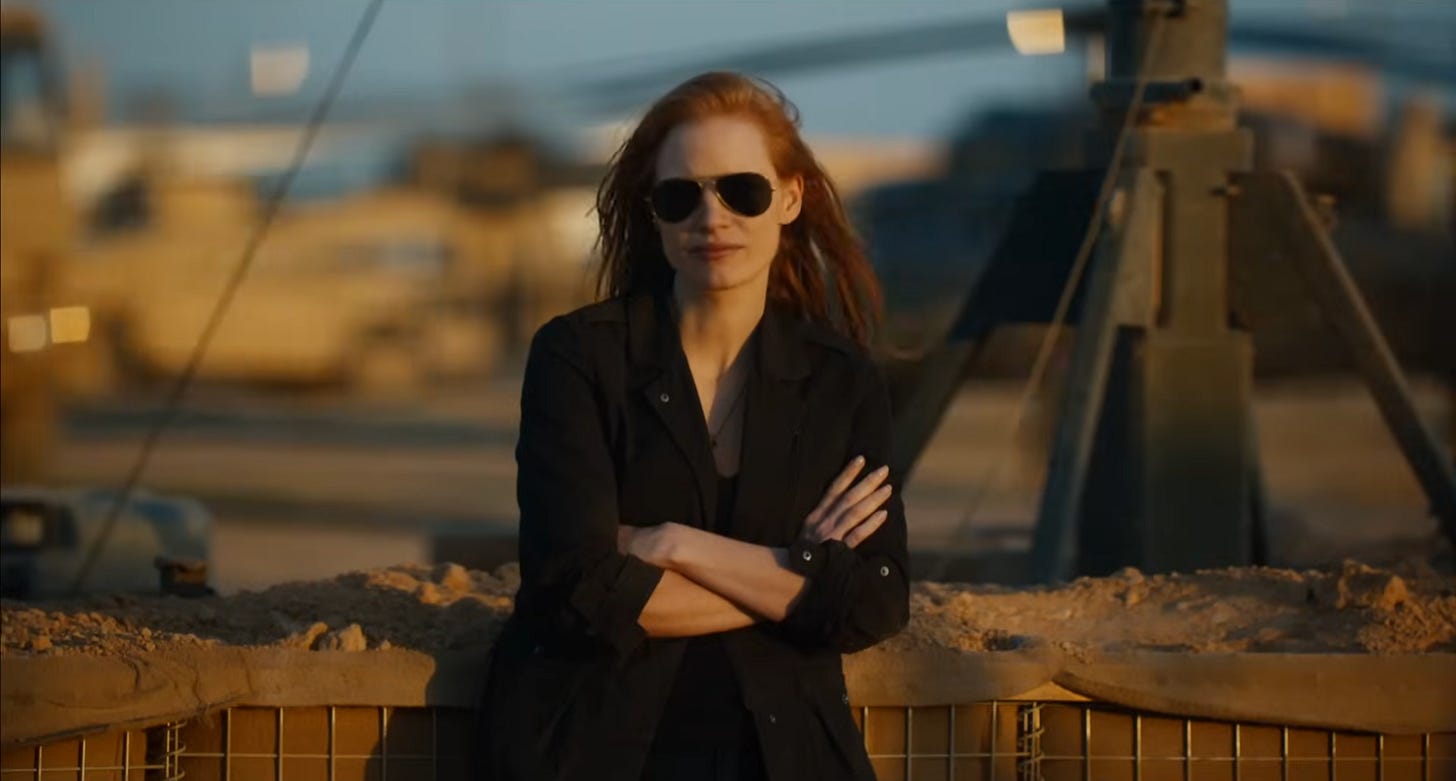
Like Ammar, Bigelow and Boal claimed that Maya was a composite character. This is more believable because several women played a role in finding bin Laden. Yet the Washington Post reported on a single CIA agent who was the character’s “real-life counterpart.” She joined the CIA before 9/11 and worked at the CIA’s Islamabad station. Her job was to identify individuals that could be recruited as spies or targeted with drone strikes. She was one of the few agents who pushed the agency to focus on bin Laden’s courier.
In the spring of 2012, this particular agent was one of several employees awarded the “Distinguished Intelligence Medal” and other “lesser awards.” Unnamed CIA officials told the Post that she was upset and hit “reply all” to an email announcement. “You guys tried to obstruct me. You fought me. Only I deserve the award,” was the “thrust” of her message. That same year she was also denied a promotion.
The Post’s report matches the character portrayed by Jessica Chastain, particularly the scene where CIA Director Leon Panetta (James Gandolfini) asks, “What else have you done for us besides bin Laden?” Maya replies, “Nothing. I’ve done nothing else.” Someone who gave their entire life to one case would be resentful of others receiving recognition. She probably struggled with the reality that no case would ever match the importance of the bin Laden case.
Throughout the film, Bigelow and Boal treat Maya like a messianic figure. After the suicide bombing by Humam al-Balawi kills Jessica and other members of her team at Camp Chapman, she says, “A lot of my friends have died. I believe I was spared so I can finish the job.” She spars with Bradley, the station chief, who believes she is “chasing a ghost” while an entire terrorist network grows around them.
“You just want me to nail some low level Mullah-crack-a-dulla so that you can check that box on your resume that says while you were in Pakistan you got a real terrorist. But the truth is you don’t understand Pakistan, and you don’t know al Qaida,” Maya replies. “Either give me the team I need to follow this lead, or the other thing you’re gonna have on your resume is being the first station chief to be called before a congressional committee for subverting the efforts to capture or kill bin Laden.”
Maya would have preferred to bomb bin Laden’s Abbottabad compound, but since the CIA “didn’t believe in this lead enough,” they authorized a night raid by SEAL Team 6. She tells Patrick (Joel Edgerton) “you’re gonna kill bin Laden for me.”
Though the raid (“Operation Neptune Spear”) takes place in a facsimile of the compound that was built in Jordan, it still feels anti-climactic. We know bin Laden is in the compound, and they’re going to kill him. And despite what Maya said, the SEALs were never going to capture the most wanted terrorist alive. The courier, Abu Ahmed, shoots at the team as they bust through the door. He is killed. Bin Laden and the others are executed as the operators methodically move floor to floor.
What creates tension is the fact that this is a violation of Pakistan’s sovereignty. The Pakistani government had no idea that stealth helicopters would swoop in during the middle of the night to kill bin Laden. There were concerns that Pakistani officials might have tipped off bin Laden if they were in the loop. The compound was a half mile from one of the country’s top military academies. So while the SEAL team collects hard drives, thumb drives, documents, DVDs, cell phones, and other electronics, and carries out bin Laden’s body, crowds form near the compound. The SEALs must flee before any Pakistani security forces arrive.
Back at Jalalabad, where the operation was launched, Maya confirms that the body they returned with is bin Laden. Except, this never happened.
Matt Bissonnette, a SEAL who recounted the raid in his memoir “No Easy Day,” recalled seeing Admiral William McRaven, the commander of Joint Special Operations Command (JSOC), kneel by bin Laden’s body. “He is supposed to be six foot four.” McRaven pointed to a seal who was the same height. That SEAL was asked to lay down next to the body.
The real-life Maya, who Bissonnette referred to as “Jen,” was crying. A few of the SEALs escorted her over the body so that she could see it. But she did not wish to see a corpse. Later, on board a military plane, “Jen” did not fly all by herself. She flew with Bissonnette and others who participated in the raid. She was sobbing and “sitting on the floor, hugging her legs to her chest in the fetal position.”
The CIA’s ‘Winning Horse’
Behind-the-scenes videos on the DVD omitted any mention of assistance from within the CIA. In the “Compound” feature, Mark Boal gives a tour of the recreated compound. “The woodwork and the glass paneling and again all the painting is taken from the open source material that we were able to find,” he shares. The flooring, he adds, was “based on images” taken by ABC News.
Yet as journalists Jason Leopold and Ky Henderson exposed, the CIA’s inspector general investigated the agency’s cooperation with the filmmakers, which began in 2010. At the time, the project was called “Tora Bora” and portrayed the agency’s failure to capture bin Laden. Boal rewrote the film after bin Laden was killed on May 2, 2011.
The CIA provided Boal with “access to CIA personnel and facilities less than a month after bin Laden was killed in order to ‘further his research.’” Bigelow and Boal later met with “at least 10 CIA National Clandestine Service (NCS) officers ‘identified as involved in the hunt’ for bin Laden and other CIA officials would go on to meet with Bigelow and Boal, and work on the ZDT script,” according to Leopold and Henderson.
The [bin Laden] operation team provided the filmmakers background on the intelligence portions of the [bin Laden] raid,” the CIA ethics report said. One CIA officer said that she “provided an overview to Boal of the intelligence case [redacted] for the public roll out plan about the Bin Laden raid…. [Redacted] advised that Boal and Bigelow visited CTC offices to get the working condition atmospherics and the personal interactions the team experienced working the [bin Laden] operation. [Redacted] commented that Boal and Bigelow were interested in the human element for the Zero Dark Thirty movie.
Boal was even invited to a “classified bin Laden awards ceremony” in a “large tent” outside of the CIA’s headquarters. “The audience was a mixture of both overt and covert personnel from across the Intelligence Community, as well as personnel from DOD and Congress. [Navy SEALs] who conducted the [bin Laden] raid were also in attendance,” the CIA inspector general’s report said.
CIA Director Leon Panetta delivered a speech with “secret” information that effectively was leaked to the production. The inspector general for the Pentagon found that Panetta had mishandled classified information, though Panetta insisted that he had no idea Boal was at the ceremony, which was hard to believe because he sat with Boal and Bigelow in May 2010 during the White House Correspondents Association dinner.
In late 2011, according to a memo obtained through a Freedom of Information Act request, public affairs officers for the CIA had five conference calls with filmmakers to “promote an appropriate portrayal of the agency and the Bin Laden operation.”
The Guardian summarized the changes that Bigelow and Boal made at the request of the CIA:
…Jessica Chastain’s Maya, the film’s main protagonist, was originally seen participating in an early water-boarding torture scene, but in the final film she is only an observer. A scene in which a dog is used to interrogate a suspect was also excised from the shooting script. Finally a segue in which agents party on a rooftop in Islamabad, drinking and shooting off an AK47 in celebration, was also removed upon CIA insistence. This was agreed to despite the documented use of aggressive dogs in US interrogations of terror suspects at Guantánamo Bay in the early days of George W Bush’s war on terror, and despite some of the photographs from the later Abu Ghraib scandal featuring dogs menacing naked prisoners…
While Matt Bissonnette, the SEAL who penned “No Easy Day,” was not explicitly depicted in “Zero Dark Thirty, it’s worth mentioning that the U.S. Justice Department came after him for spilling secrets while officials like Panetta never faced any consequences. Bissonnette eventually forfeit over $6 million to the U.S. government.
Finally, the Senate intelligence committee uncovered the “Panetta review” while putting together their report on the CIA’s torture program. Its conclusions, unlike the agency’s official response, matched the committee’s findings. When staffers working for the committee downloaded this document to prevent it from being destroyed, the CIA hacked into Senate computers.
“According to sources familiar with the CIA inspector general report that details the alleged abuses by agency officials,” journalists Ali Watkins and Ryan Grim reported, “CIA agents impersonated Senate staffers in order to gain access to Senate communications and drafts of the Intelligence Committee investigation.”
One source said, “If people knew the details of what they actually did to hack into the Senate computers to go search for the torture document, jaws would drop. It's straight out of a movie.”
But no one was ever held accountable. In fact, everyone from CIA Director John Brennan, who inspired the “Wolf” character in “Zero Dark Thirty,” to lower-level agents were cleared by an “accountability review board” that was overseen by former U.S. Senator Evan Bayh.
At the White House correspondents dinner, Bayh sat with Bigelow, Boal, and Panetta.
Comments ()