
‘NAZA’ Further Exposes Media Complicity In War On Gaza
The fact that "NAZA" is necessary viewing at this juncture is an indictment against the press in the so-called civilized and free world.
Many of the revelations in “NAZA” about the Israeli military and its vast use of artificial intelligence and remote control warfare to carry out genocide against the Palestinians were previously reported by the filmmakers and various colleagues. So what makes the documentary compelling is the valiant effort undertaken to inform a mass audience when the professional media class in Israel, the United States, and much of Europe tend to shun this kind of exposé.
“NAZA,” with the subtitle, “A Window Into Systems of Mass Killing,” was directed by Israeli filmmakers Yuval Abraham and Rachel Szor. Both won Oscars in 2025 for co-directing “No Other Land” with Palestinian filmmakers Basel Adra and Hamdan Ballal. In October, it screened at 85 arthouses and independent or nonprofit theaters in 30 cities in the U.S. and Canada. It will be posted online by the Guardian in late November.
The documentary features firsthand accounts of Israeli military operations in Gaza from 24 anonymous former and current military officers from Unit 8200, which is Israel’s elite cyber warfare and signal intelligence agency. Several of the officers could be considered whistleblowers, who clearly are dealing with moral injury from the heinous acts that they carried out. Others are unrepentant or downplay the role that they have played in the unfolding death and destruction. But every one of them are media sources.
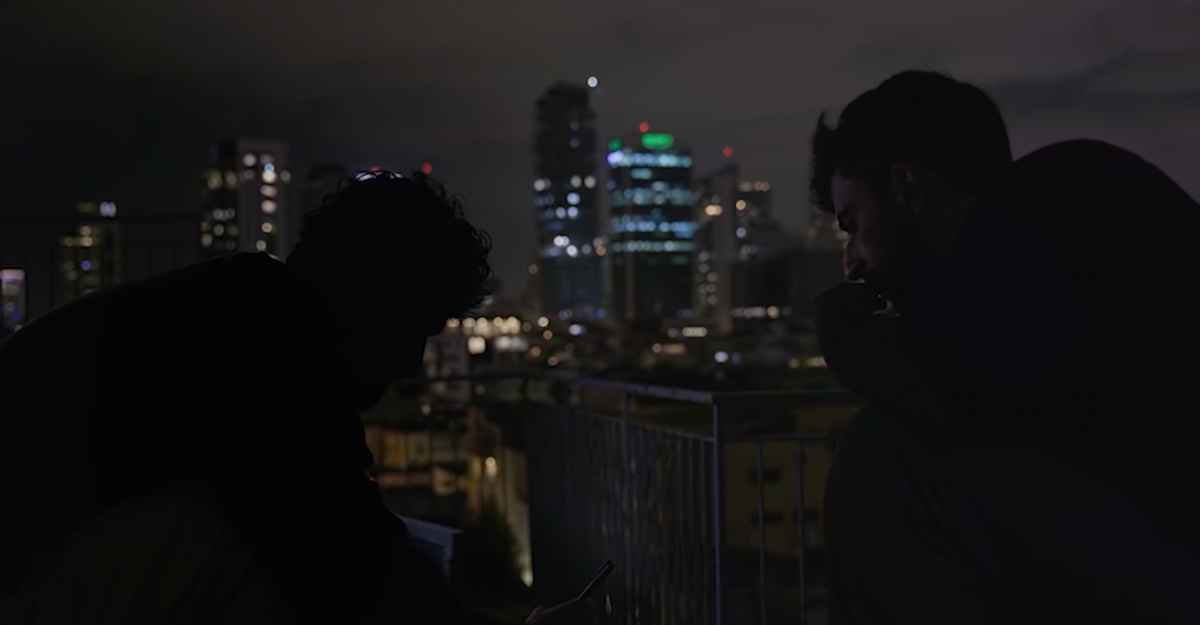
As the sources provide a window into a system that has massacred tens of thousands of Palestinians, the camera provides a window into high-stakes investigative journalism rarely performed in the country. One of the primary shots that we see is Abraham interviewing one of the 24 sources on a rooftop in Tel Aviv. The film immediately draws attention to the filmmakers’ approach to source protection—digitally altering their silhouettes, changing their voices, and blurring and scrambling the drawings that they sketch for viewers.
Szor, who was responsible for the cinematography, scans the side of residential apartments in Tel Aviv. The camera pans or tilts slowly like a military drone that peeps on Palestinian families in their homes. It trains our attention on urban Israelis, as they ritualistically tune into the evening news. These shots appear in between stories of war crimes, and because Israeli news channels often avoid coverage of the war on Gaza, we presume that the Tel Aviv denizens are indifferent or oblivious to the stories being shared.
The stripped-down nature of the film—with little to no music, visual effects, and minimal archival sequences—heightens our sensitivity to the dehumanizing language used by Israeli officers. Each soldier speaks about how they enabled thousands upon thousands of assassinations and rely on AI to exponentially increase targets.
NAZA is the Hebrew acronym for “collateral damage.” According to the sources interviewed, it specifically refers to a number that is assigned to a Palestinian as part of an AI system known as Lavender. Essentially, a calculation is routinely incorporated into an assembly line of assassinations, with the deliberate bombing of family homes an integral part of targeting “suspected” Hamas or Palestinian Islamic Jihad militants. We’re also informed by at least one source that the Israeli military accepts a 15 percent margin of error, which helps soldiers manufacture more targets.
The Israeli government built Palestinian telecommunications infrastructure for the total control and subjugation of a population. The system is meticulously outlined in macabre and twisted detail: hacking into the phone of a 12-year-old girl, blackmailing war crimes survivors who petition the United Nations with evidence of homosexuality, dogs eating Palestinian bodies that lay rotting in the rubble, and location tracking known as “Where’s Daddy?” So stomach-turning that it’s almost a relief when one officer acknowledges, “The Nazis were the devil, but what am I?”
Only after Abraham and Szor have presented these officer testimonies do we see exactly what it means to face a campaign of extermination for the past three years. The video that appears shocks our conscience. Sterile language and coldhearted rationalizations may have momentarily numbed us, however, we are reawakened by the ghastliness of the daily violence against Palestinians in Gaza. These are images that once appeared in social media feeds regularly, though platform algorithms have increasingly insulated us from evidence of the horror.
I left the theater thinking about the U.S. government’s own system of mass killing that relies on remote control warfare similar to what is presented in “NAZA.” Its development was influenced by Israel, and this system rapidly expanded under President Barack Obama, who was responsible for an assassination industrial-complex that involved drone and air strikes in Pakistan, Yemen, and Somalia. Hundreds of civilians were killed as terrorism “suspects” (several on kill lists) were vaporized. (In fact, the film “Eye In the Sky” (2015), which revolves around drone warfare in Somalia, is mentioned in “NAZA.”)
In the 2010s, headlines frequently brought attention to U.S. attacks on weddings as well as funerals of drone strike victims. Rescuers were targeted, too. Drone whistleblower Daniel Hale, who was later prosecuted and sentenced to prison, brought attention to the sheer amount of civilian deaths caused by “targeted” killing operations. For example, during “one five-month period” of Operation Haymaker in northeastern Afghanistan, “nearly 90 percent of the people killed in airstrikes were not the intended targets.” A certain amount of NAZA was acceptable, though the carnage definitely never reached the level seen in Gaza.
“NAZA” is incredibly effective low-budget filmmaking, yet the fact that it is necessary viewing at this juncture is an indictment against the so-called civilized world. As Abraham and Szor note, their film built on reporting from the Guardian, the Israeli-Palestinian outlet +972 Magazine, and the Hebrew-language outlet Local Call that was published between 2023 and 2025. Media in Israel, the U.S., and Europe lashed out or collectively shrugged.
Israeli journalist Gideon Levy has emphasized that the Israeli government bars Israeli and international journalists from entering Gaza. Outlets like CNN cooperate with an Israeli military censor that demands the removal of details that clash with their narrative that Israel is the “victim” and genocide is a legitimate response to Palestinian militants. Media executives, such as David Ellison, exact a significant amount of control over what is broadcast and published, and the merger between Paramount Skydance and Warner Bros aids Israel in the country’s continued attacks on Palestinians. US media organizations may speak out against President Donald Trump but not when he proposes ethnic cleansing against Palestinians.
Much of the U.S. press still refers to the genocide as an “Israeli-Hamas war.” FAIR’s Gregory Shupak points out in reality this is a “war on Palestinians’ physical survival, on their food and clean water supplies, on their homes, healthcare, schools, children and places of worship—a war, in other words, on the Palestinians as a people.” That is apparent in “NAZA,” and all of this violence is perpetrated with the full support of the U.S. government, which is still sending billions of dollars in arms to Israel for this mass killing.
Credit Abraham and Szor for poking another massive hole in the propaganda fueled by the Israeli and U.S. governments. There is an obvious reason why Prime Minister Benjamin Netanyahu and his apartheid government are threatening to revoke the citizenship of the filmmakers and prosecute any soldiers who talked to them. But Szor is absolutely right when she says that it would not be extraordinary to hear Israeli soldiers speak about what they’ve done if reporters in Israel and the U.S. bothered to seek out their testimonies.
*For further reading, I recommend the well-researched book “The Complicit Lens” by media scholar Robin Andersen. (My interview with Andersen in June.)
This article was also sent to paid subscribers of The Weekly Matinee.
Comments ()