
National Security Excuses Continue To Flop As Trump Pushes Press Ban
US judge further dismantled belated and lazy national security argument offered by Trump officials to justify press ban
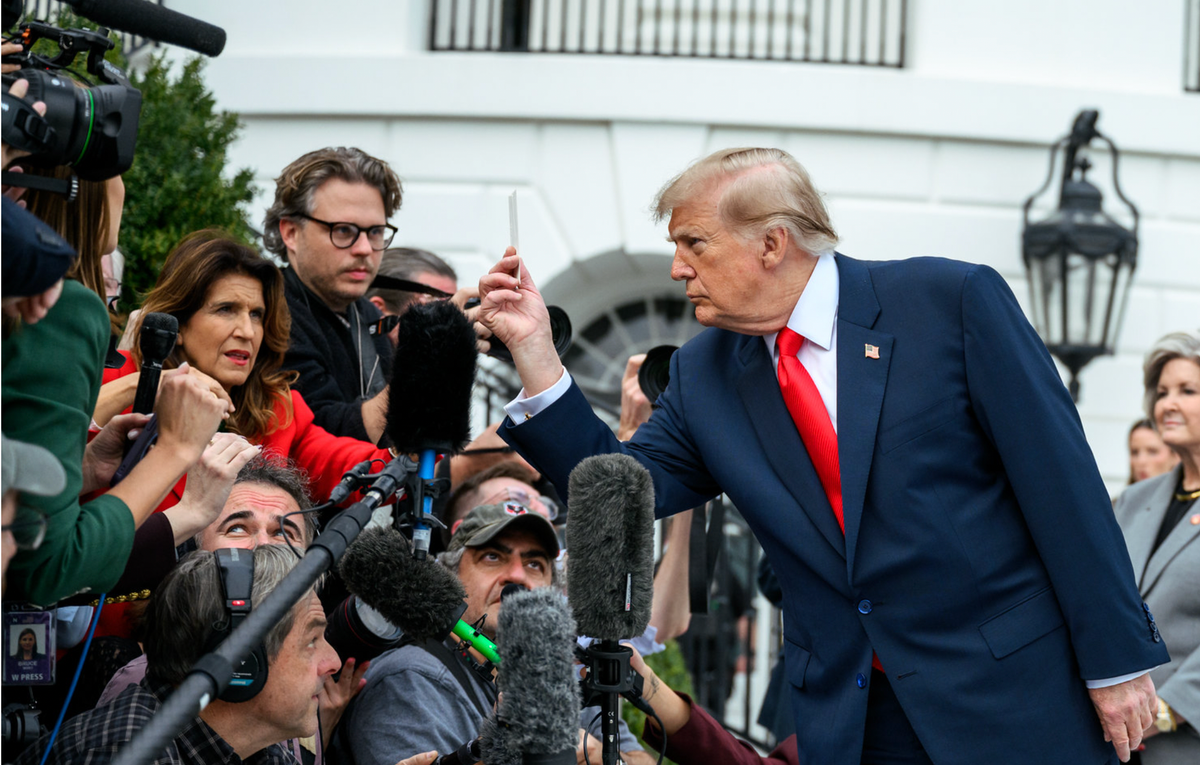
A United States judge extended an injunction that ordered President Donald Trump’s administration to grant CNN, MS NOW, and Politico correspondents access to the White House.
Not only did Judge Timothy Kelly reaffirm the fact that revoking “their hard passes likely violated their Fifth and First Amendment rights,” but the judge also dismantled the belated and lazy national security argument that was offered by Trump officials.
“[T]here is practically nothing national security-related in the record connected to the President’s decision,” Kelly declared in the court’s decision [PDF].
Referring to supposed “reporting incidents” in letters that were sent to the media outlets on September 22, the judge said Trump officials “do not even bother to identify what specific information” in any of the “incidents” was “allegedly classified or sensitive.”
Trump announced on September 18 that he had banned the news media outlets. Their correspondents were subsequently denied access to the White House, and the outlets sued Trump and several White House officials.
The day that the ban was announced Trump said it was a “very simple ban. I don’t want them in my office. I don’t want them here. I would say the ban will go as far as you can.” (He also joked about “having more bans going than any human being.”)
A little less than a week later, Kelly issued a 14-day injunction that instructed Trump officials to “return, reinstate, and restore the White House ‘hard pass’ press credentials held by employees of CNN, MS NOW, and POLITICO.” Immediately, there were reports from the three media outlets that the Trump White House was flouting this court order.
Previous presidential administrations have routinely invoked “national security” to stifle journalism, crack down on media sources, shut down lawsuits challenging rights violations, and conceal the release of information on torture, mass surveillance and other crimes committed in the U.S. and abroad. This was especially true in the aftermath of the September 11th attacks.
As Trump lawyers try to use this playbook to ban reporters, they bring further attention to how this excuse has always been rooted in a desire to get away with flagrant abuses of power.
Trump lawyers maintain that they sent letters on September 22 that appropriately notified the reporters of the reasons why they could no longer access the White House.
The letters mentioned alleged "reporting incidents," which Kelly summarized in his first ruling: “CNN disclosed ‘top-secret’ construction details related to the East Wing bunker.” “MSNOW reported on an alleged leak investigation,” which, “if it existed, would be nonpublic sensitive law enforcement information.” “POLITICO published a document detailing funding for the White House ballroom containing intricate descriptions of how the Secret Service would invest in security improvements.”
Remarkably, Trump lawyers invoked 18 U.S.C. § 798 because it contains a “federal criminal prohibition against publishing classified information.”
The anti-espionage statute relates to “communications intelligence” or “cryptographic systems.” NSA whistleblower Edward Snowden was accused of violating the statute when he exposed secret surveillance programs and alerted millions of people to rampant assaults on their privacy.
Information related to the White House ballroom or an alleged leak investigation would never fall within the scope of information covered, something that Kelly acknowledged. The court was also “unaware of any occasion in which the government [had] sought to apply that statute—on the books for over half a century—to reporters similarly situated to Plaintiffs.”
Kingsley Wilson, the press secretary for the Pentagon, submitted a declaration to the court, where she highlighted Pentagon Chief Pete Hegseth’s decision to restrict media access. Kelly recognized that this is entirely irrelevant to the White House’s handling of the press. But also those restrictions were deemed unconstitutional by a court, too.
“[Wilson] does not purport to know much about the White House or the President’s decision here,” Kelly emphasized. “Thus, it matters little that even if, after discussions with people who work there, she thinks that the decision ‘would be effective in reducing the amount of information that is published that undermines national security.’”
Kelly mentioned that the letters referring to so-called “reporting incidents” seem to “conflate concerns about otherwise protected speech,” such as “trafficking in verifiable falsehoods,” with “national security concerns,” and there is no evidence that Trump was planning a “national security” ban against reporters.
CNN reporter Betsy Klein had her hard pass renewed six months after working on a story that was headlined, “Inside Plans to Rebuild the ‘Top-Secret’ Bunker Beneath the White House East Wing.” Kelly appropriately scoffed at the fact that the Trump White House have now tried to ban her.
Freedom of the Press Foundation advocacy director Seth Stern noted, “The reports the government cited are years old and one was even based on a briefing from the vice president. Trump beats up on the free press not because of national security but because he’s terrified for the public to see what he and his administration are up to in the people’s house behind closed doors, whether it’s letting classified tech go missing or almost starting a war based on an AI hallucination."
Though Kelly continues to see through this extraordinarily weak “national security” argument, he has not sanctioned any lawyers (something the Freedom of the Press Foundation (FPF) urged). Kelly did not pledge to hold officials who violate his order in contempt.
According to the Knight First Amendment Institute, “The ruling did not address the White House’s continued ban on CNN and Politico serving in the White House press pool, the group of reporters who cover the president in smaller spaces like the Oval Office and aboard Air Force One.”
While it is positive that a court has rejected Trump’s press ban, until there are consequences for the Trump administration it is hard to believe that they will stop trampling over the rights of journalists to access the White House.
Comments ()