
Another Judge Sees Through Trump's Anti-Press Agenda
One of the more pernicious anti-press policies pursued by Trump officials was blocked by a US judge earlier in September.
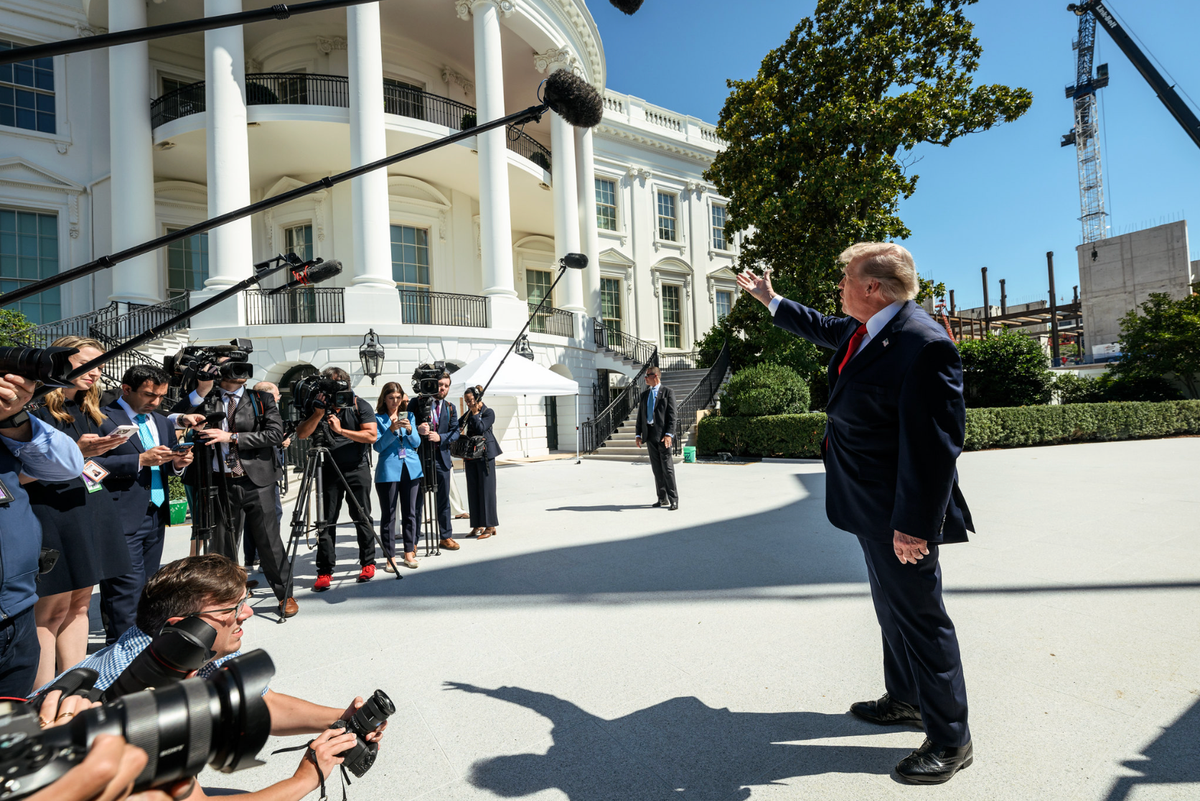
The attacks on the press by President Donald Trump’s administration that garner the most attention tend to be particular acts of retaliation, like barring a news outlet from the White House, subpoenaing the records of a reporter, or threatening a broadcast media organization with an FCC license review.
Yet more pernicious are sweeping policies that give Trump officials unchecked authority to stifle future acts of journalism. Such policies make Trump one of the most anti-press presidents to ever hold office.
One example is the media restriction policy that Pentagon Secretary Pete Hegseth imposed on military reporters, which a United States judge declared unconstitutional. A lesser known example is the cap on visas for foreign journalists that was recently halted by a United States judge.
On July 17, the Department of Homeland Security (DHS) adopted a new rule to limit visas for international students, academics, and journalists. It capped “I visas” for foreign press representatives at 240 days.
The NewsGuild-CWA (TNG-CWA), along with several other labor unions, sued DHS about a month later.
“Forcing foreign journalists to reapply frequently” would create “serious risks that visas could be denied in retaliation for unfavorable reporting, thereby placing government officials in a position to punish journalists for exercising their First Amendment rights,” the TNG-CWA argued.
The coalition that sued the DHS contended that the cap violated the Administrative Procedure Act (APA), which applies to how the government adopts regulations.
Judge Frank Saylor of the U.S. District Court of the District of Massachusetts ruled that DHS’s action was indeed “arbitrary and capricious” under the APA. He also determined that the public interest favored blocking the visa rule while the lawsuit is pursued in court.
“International journalists make significant contributions to the United States, in particular, contributing to the open exchange of information, ideas, and opinions that are the hallmarks of a free and democratic society,” Saylor recognized. “[The rule] directly threatens those benefits to the substantial detriment of the American public.”
As Saylor described in the court’s decision, journalists may apply for extensions of their visa, however, the process “calls for the entirely unguided exercise of discretion by government officials, with no recourse and no appeal.”
“[T]he possibilities for abuse are rampant—in particular, the obvious likelihood that the visas of foreign journalists who are critical of the government (or, more particularly, DHS officials) will not be renewed,” Saylor added.
Saylor acknowledged the potential for retaliation against U.S. journalists who work abroad. If a journalist from a particular country had their visa renewal denied, then that country could engage in a tit-for-tat action by revoking the visa of a U.S. journalist.
The court was partly persuaded that abuse was inevitable because “DHS provided an exceptionally short, and barely legal, 32-day period for public comments” Met with “strong opposition” from 22,000 commenters, DHS dismissed those comments and “offered almost entirely conclusory statements, non sequiturs, and statements of ‘belief’” for the rule “without supporting reasoning.”
Adam Rose, deputy director of advocacy for the Freedom of the Press Foundation celebrated the injunction. “As a nation of immigrants, this ruling is a victory for the United States. While several different groups would have been impacted, the administration’s targeting of journalist visas is fundamentally un-American and a betrayal of the First Amendment.”
Restricting visas for foreign journalists is clearly driven by the same animosity and bigoted attitudes that fuel the Trump administration’s widespread crackdown on immigrants. That crackdown has already led to ICE detaining a number of immigrant journalists and attempting to deport them. Journalist Mario Guevara was chillingly deported to El Salvador almost a year ago.
While there is no legitimate government reason to cap visas, that does not mean that DHS won’t find an appeals court or Supreme Court willing to allow another abuse of power by the Trump administration. But until that time, foreign journalists may more freely operate in the U.S. and complete their assignments.
Comments ()