
Judge Fails Washington Post Reporter Who Had Devices Seized By FBI
The Trump Justice Department deceived the court in order to target a journalist, and yet a magistrate judge did very little to hold the government accountable.
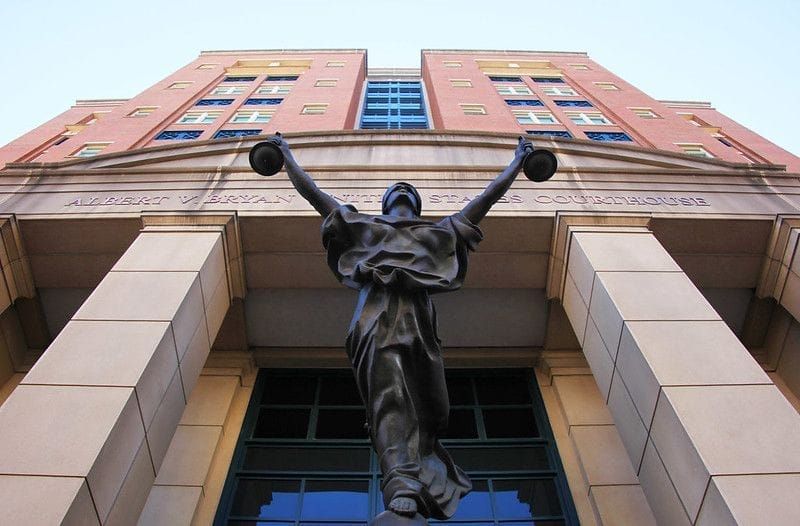
A United States magistrate judge ruled that President Donald Trump’s administration “restrained” the First Amendment rights of the Washington Post and its reporter Hannah Natanson when the FBI seized her electronic devices, which contained journalist “work product” and “documentary materials.”
However, Magistrate Judge William Porter did not single out the seizure as unlawful and a clear violation of the First Amendment. Instead, he directed most of his frustration at high-ranking officials at the Justice Department (DOJ), who failed to identify the Privacy Protection Act when applying for a search warrant.
Porter refused to allow the FBI to search materials on the devices that agents seized, but he denied the Post and Natanson's request to force the government to return Natanson's devices.
According to the court decision [PDF], the government’s search warrant application did not definitively state that Natanson was not a target of an Espionage Act prosecution. The court learned that Natanson “was not a focus of the investigation only through press reports published the day the warrant was executed.”
If the Privacy Protection Act had been part of the application, the court could have made a “real-time decision” to deny the government’s request for a search warrant and instructed prosecutors to instead proceed by subpoena. “At the very least, [the court] would have asked more questions.”
On January 14, the FBI seized Natanson’s devices as part of an Espionage Act prosecution against Pentagon contractor Aurelio Perez-Lugones. The raid occurred after Perez-Lugones was arrested but before a grand jury indicted the Pentagon contractor for allegedly disclosing classified information to a member of the press.
FBI agents took a personal MacBook Pro, a personal Apple iPhone 13, a voice recorder, and a terabyte hard drive. They also took another MacBook Pro—a work laptop that belonged to the Post.
The magistrate judge granted the Post’s motion to halt “review” of Natanson’s devices a week after after the raid, and the court considered another request from the Post and Natanson to force the government to return the property.
In the decision, which was issued on February 24, Porter stated, “The government seized all of Ms. Natanson’s work product, documentary material, and devices, terminating her access to the confidential sources she developed and to all the tools she needs as a working journalist. The government’s proposed remedy—that she simply buy a new phone and laptop, set up new accounts, and start from scratch—is unjust and unreasonable.”
"Given the documented reporting on government leak investigations and the government’s well-chronicled efforts to stop them, allowing the government’s filter team to search a reporter’s work product—most of which consists of unrelated information from confidential sources—is the equivalent of leaving the government’s fox in charge of the Washington Post’s henhouse."
But Porter only went so far as to order an “independent judicial review of the seized materials” to determine what is relevant to the government’s Espionage Act prosecution against Perez-Lugones.
As Porter recounted, on January 12, the DOJ submitted its first search warrant application and that referred to a “first-person article” by Natanson, where she described how she had “posted her secure phone number to an online forum for government workers and amassed more than 1,000 sources.” Natanson mentioned that “federal workers frequently reaching out to her to share frustrations and accounts from their offices.”
“[T]he Court became concerned about both the scope of the proposed search warrant and the government’s apparent attempt to collect information about Ms. Natanson’s confidential sources. That evening, the Court rejected the government’s proposed search warrant and explained its concerns to the [Assistant U.S. Attorney Gordon Kromberg] and the Principal Deputy Assistant Attorney General of the National Security Division.”
The next day “several versions” of the second search warrant application were rejected before the court approved a search warrant ‘limited to all records and information, including classified and/or national defense information, from the time period October 1, 2025, to the present, which constitute records received from or relating to Aurelio Luis Perez-Lugones, as evidence of violations of [the Espionage Act].’”
Previously, the Dissenter reported on the “disciplinary complaint” that was filed against Kromberg by the Freedom of the Press Foundation (FPF). The complaint urged the Virginia State Bar to take action against him for failing to inform the court about the Privacy Protection Act and authorizing the seizure of a journalist’s work product.
The state bar declined to address the alleged misconduct. “Whether a search warrant was obtained through misrepresentation of the law falls within the authority of the court to determine,” the state bar wrote in a letter.
“This is the latest example of attorney disciplinary offices finding any excuse to not confront the rampant misconduct by prosecutors and other lawyers inside the Trump administration,” declared FPF advocacy director Seth Stern. “Disciplinary offices need to rise to the moment and stop protecting the people they’re supposed to regulate.”
The magistrate judge shared that it had not considered the Privacy Protection Act when reviewing the warrant application and blamed the government for this oversight.
“This Court had never received such an application and, at the time it approved the warrant, was unaware of the PPA. This Court’s review was limited to probable cause, and the Court accepts that gap in its own analysis,” Porter contended. “But the government’s failure to identify the PPA as applicable to a request for a search warrant on a member of the press—and to analyze it in its warrant application—is another matter. This omission has seriously undermined the Court’s confidence in the government’s disclosures in this proceeding.”
Porter added, “The Court’s communications with the government over two days were not limited to the local [Assistant U.S. Attorney]. Counsel from the highest levels of the DOJ participated in at least one of those calls. Many government lawyers had multiple opportunities to identify the PPA as controlling authority and to include an analysis of it in the warrant application. None of them did.”
The magistrate judge said this misconduct by the government had disturbed the “baseline posture of deference” that the court typically shows federal prosecutors. Yet remarkably, Porter did not sanction Kromberg or any other official who arguably deceived him.
Porter also took the government “at its word” when it came to pronouncements made by prosecutors about “national defense information” on Natanson’s devices.
The Trump administration openly sought a search warrant because they were upset that Natanson had amassed 1,000-plus sources, who were providing her scoops. They used the prosecution against Perez-Lugones as a pretext, and still, the magistrate judge seemingly looked past the alarming chain of events, which led Natanson and the Post to demand that government return their property.
As Stern said, “[T]oday’s order didn’t go far enough. Judge Porter should have required all of Natanson’s materials seized pursuant to the deceptive warrant application to be returned to her. And he should not have credited the administration’s claims that any of the seized materials posed a national security threat without strict proof."
"Judge Porter acknowledged [that] this administration, even more so than others, has a long track record of falsely claiming national security threats to protect itself from embarrassment and further its political agenda," Stern added. "It has earned zero deference from the judiciary on claims of national security threats, particularly when press freedom is at stake."
Both the magistrate judge and the Virginia State Bar failed Natanson, the Washington Post, and other members of the press. Reporters need individuals who can hold Trump officials accountable to actually hold those officials accountable.
Attacks on freedom of the press by Attorney General Pam Bondi, the DOJ, and the broader Trump administration are well documented. Declining to forcfully defend the First Amendment jeopardizes legal protections for everyone who regularly engages in journalism.


Comments ()