
Project Censored At 50 (And The Independent Media That Can Save Us)
“What we need is a truly independent free press reporting factually, transparently, and ethically in the public interest,” says Project Censored's Mickey Huff
When Project Censored launched in 1976, its founder Carl Jensen set out to confront what he described as the “systematic omission of certain issues from our national media.”
The media literacy project has documented and analyzed “censored” news as well as “junk food news” and “news abuse” for 50 years. Its director Mickey Huff is hugely supportive of the Dissenter, which is built around covering stories involving press freedom, whistleblowers, and government secrecy that rarely receive regular attention in the establishment press.
In fact, current staff at Project Censored enthusiastically back my work. Editor at large Andy Lee Roth, associate director Shealeigh Voitl, social media manager Reagan Haynie, digital media and website manager Kate Horgan, outreach and engagement manager Mischa Geracoulis, associate producer Eleanor Goldfield, and operations manager have all promoted the Dissenter’s journalism.
I have appeared on the project’s radio show hosted by Huff and Goldfield countless times. It was Censored Press, which publishes their books, that worked with me to produce “Guilty of Journalism: The Political Case Against Julian Assange.”
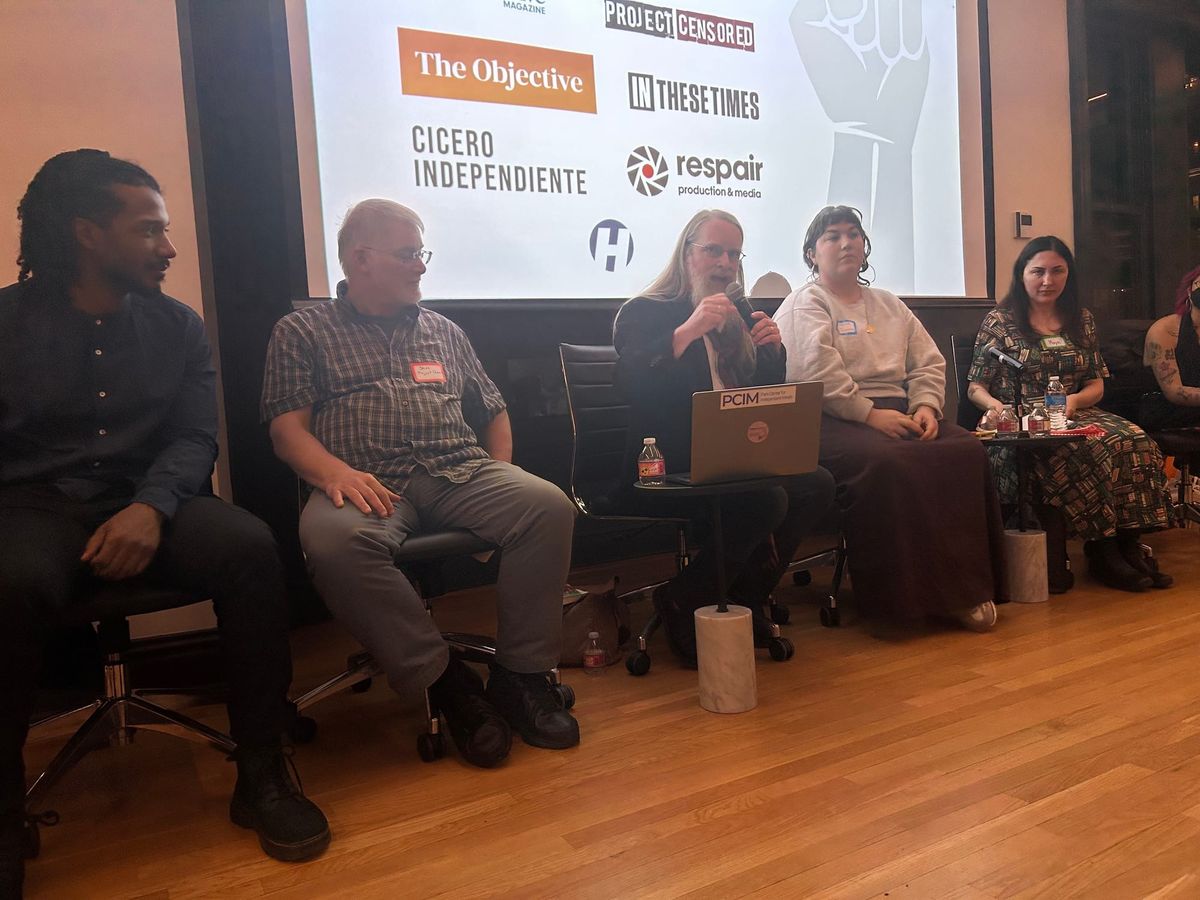
On May 7, Project Censored marked its 50th anniversary with an event at the Haymarket House that celebrated independent journalism in the Midwest. We all enjoyed food from the Nabala Cafe, a Palestinian eatery and coffee shop in Uptown.
The event was not only a chance for me to meet Project Censored staff in person for the first time, but also an opportunity to collectively appreciate media outlets that are making a difference in an extraordinarily difficult moment.
Editors from publications that have been covering social justice issues for decades—The Progressive, In These Times, and Truthout—were joined by editors from new and vibrant journalism projects—The Objective, Respair Media, and Cicero Independiente.
Huff, who moderated the discussion, acknowledged all that plagues journalism these days, however, rather than dwell on doom and gloom, the event focused on the ways that these organizations carry on the honorable tradition of independent journalism.
Back in 2024, I interviewed Truthout editor at large Maya Schenwar and Lara Witt, the editor-in-chief of Prism. Both co-founded the Movement Media Alliance to build solidarity among a coalition of journalists, strengthening their ability to confront challenges we face daily. Schenwar challenged the notion that journalists should not be involved in activism or organizing their communities.
“Journalism itself is action,” Schenwar said. "Journalists are not separate from communities. We’re writing from our communities.” She also contended “we’re intermingled” and as organizers we know what stories should be covered.
Steve Macek, who is part of Project Censored's campus affiliates program, outlined how college or university students contribute to the project by researching stories that go ignored by the establishment press and writing entries for the annual "Top Censored Stories and Media Analysis."
James Salanga of the Objective, which analyzes and reports on inequities that are embedded in journalism, spoke compellingly. The publication, which is somewhat like the Columbia Journalism Review or Poynter, critiques many facets of the media ecosystem.
But Salanga said what separates the Objective from these outlets is how it stands up for marginalized people and assesses journalism from the “standpoint of identities and how those identities are intrinsically important.” That means there is no hesitation when representing the perspectives of Palestinians or transgender people, which are often taboo topics in the establishment press.
I listened intently to Sabrina Beydoun, the digital and audience communications director for Cicero Independiente. It is a hyperlocal journalism project that is dedicated to reporting on communities in Cicero and Berwyn, which are both suburbs of Chicago.
Beydoun said the people of Cicero and Berwyn have “real human needs” and that “necessitates journalism.”
“As long as communities exist, there will need to be media that serves them,” Beydoun added, mentioning that Cicero Independiente was the only independent newsroom serving these communities when it launched.
I started a hyperlocal journalism project in the Chicago suburb of Elmwood Park, where I live. What Beydoun described matched my experience over the past year. I, too, setup a publication to confront the loss of local journalism and how the community basically lived in a “news desert.”
“With all the layers of institutional failure,” Beydoun declared, “the hope is independent journalism can be a source of truth that doesn’t lose public support.”
Damon Williams introduced us to Respair Media, emphasizing how it was different from typical print or online publication. Essentially, the project built an audio archive to celebrate people engaged in struggles for freedom and justice. He shared how Respair might focus on the impact of a corporation poisoning the environment in a podcast or film, however, those productions would also highlight the people standing up to the corporation.
With an eye toward creating movement journalism, Respair connects with communities that need information about past organizers, like Hazel Johnson, to recognize how they can be part of the “process of liberation.”
From the Progressive, associate editor Rachel Monk recalled that the magazine had focused on publishing articles from Palestinian writers. “Anywhere that there is war” or “people fighting international militarism, that’s where we want to be embedded in those communities.”
“We are here to uplift the voices of people who have been told their voices don’t matter,” Monk said.
It was exciting to hear Monk share how printing a traditional magazine is important to readers of the Progressive. People, including younger generations, want to hold something in their hands. That gives the magazine an opportunity to present a “curated package” and design it in a way that publications really cannot do online.
Ari Bloomekatz, the executive editor of In These Times, responded to a question about breaking through the algorithms that control so much of the information that we consume. He similarly demonstrated the value of printing a magazine that could be shared.
“Make your stuff utilitarian,” Bloomekatz declared. He showed that a recent issue of In These Times had a “Know Your Rights” guide for ICE that could be pulled out. The back of the magazine’s cover had a “Fuck ICE” sign that readers could hang on the wall.
It is harder and harder for the Dissenter to grow its base of subscribers and readers, which is necessary to power the newsletter. However, the answer is not necessarily spending hours upon hours trying to figure out how to game the system of online algorithms.
Schenwar had it right. Independent publications need each other. Collaboration will “help us break through these algorithms when competing for clicks is actually breaking us,” she said. (That is one reason why I donate monthly to the Movement Media Alliance.)
If outlets allow their articles to be reprinted, that’s a key way they can expand their reach.
Press freedom, a regular focus of the Dissenter, is inextricably tied to the crisis in journalism. The crisis in journalism is driven by many factors, including a lack of funding and an erosion of trust in media institutions. However, I do not believe that most people distrust independent media. It is my sense that they increasingly turn to smaller outlets that have demonstrated their value time and time again.
While that fractures and divides an audience, it means that those people form an appreciation and even kinship with the writers, editors, and staff of that publication, podcast, or news show. Those people often become longtime supporters of independent media.
As Mickey Huff has said, we need media literacy education for all, and it should start at an early age. Project Censored plays a key role in documenting "the news that did not make the news," and the organization will continue to fight for media democracy.
“What we need is a truly independent free press reporting factually, transparently, and ethically in the public interest,” according to Huff. “[N]ot one owned by corporate conglomerates and big tech mogul billionaires blasting oligarchic propaganda and AI slop.”

Comments ()