
Judge Refers To War On Iran In Ruling That Slaps Down Pentagon’s Anti-Press Policy
"[I]t is more important than ever that the public have access to information from a variety of perspectives about what its government is doing," the judge declared
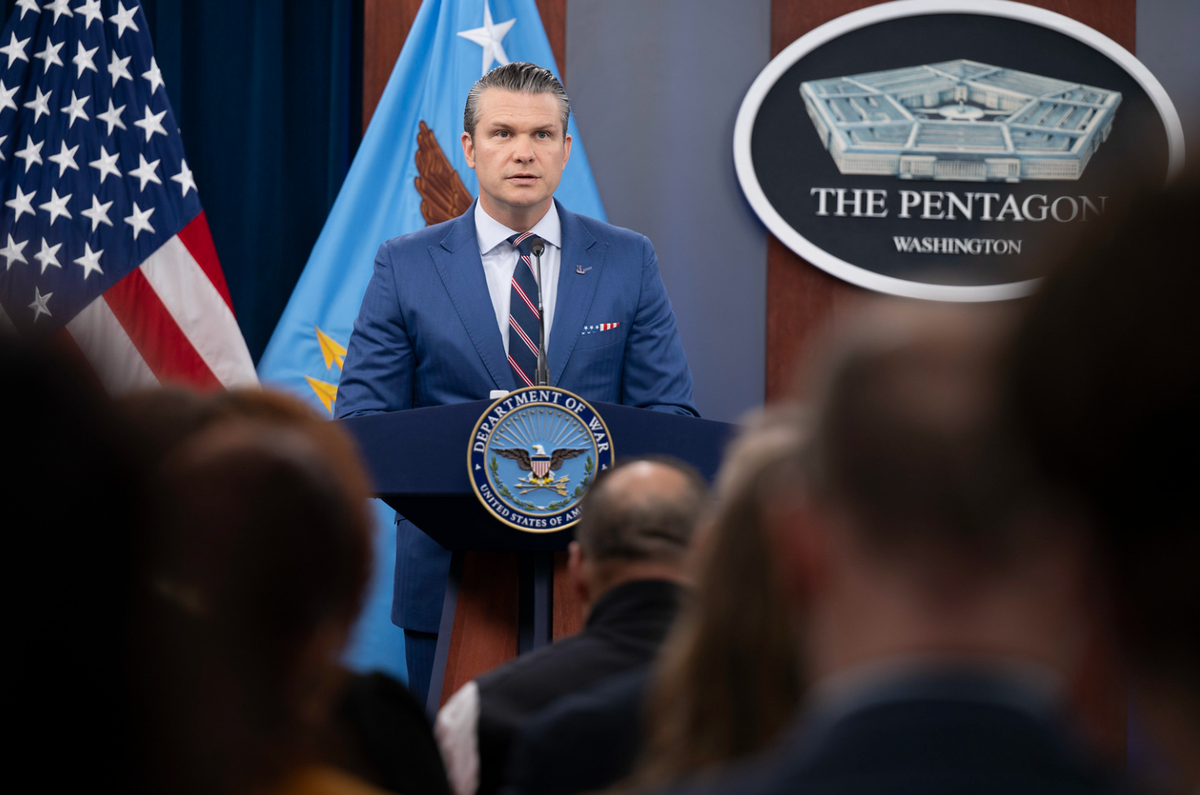
A United States judge ruled that the Pentagon’s restrictions imposed on reporters are unconstitutional and “vacated” the “challenged provisions” of the policy. He defended the right of members of news media to solicit information from sources and upheld the public’s right to know information about their government.
“[I]n light of the country’s recent incursion into Venezuela and its ongoing war with Iran, it is more important than ever that the public have access to information from a variety of perspectives about what its government is doing,” Judge Paul Friedman declared [PDF]. “So that the public can support government policies, if it wants to support them; protest, if it wants to protest; and decide based on full, complete, and open information who they are going to vote for in the next election.”
Friedman determined that the policy developed by Defense Secretary Pete Hegseth imposed “viewpoint-discriminatory restrictions” on reporters with credentials to access Pentagon facilities in violation of the First Amendment of the U.S. Constitution. It also is “vague” in violation of due process rights under the Fifth Amendment.
He ordered the Pentagon to reinstate credentials for Eric Schmitt, Helene Cooper, Greg Jaffe, John Ismay, Carol Rosenberg, and W.J. Hennigan—all reporters for the New York Times. However, the Pentagon immediately announced that it would appeal the decision.
In September 2025, Sean Parnell, an official in the public affairs division of the Pentagon, issued a memo [PDF] that required credentialed reporters to acknowledge that they would lose access if the Pentagon determined they had disclosed “classified national security information” or “controlled unclassified information.”
Reporters for the Times and various other news media outlets refused to agree to the policy, and Hegseth responded by yanking the credentials of dozens of reporters who had been assigned to the Pentagon. Hegseth then welcomed individuals into the Pentagon, who as the judge noted were “willing to publish only stories that [were] favorable to or spoon-fed by Department leadership.”
The Times and its reporter Julian Barnes sued the Pentagon in December 2025. They were backed by the Pentagon Press Association, Reporters Committee for Freedom of the Press (RCFP), and the American Civil Liberties Union, which filed briefs of support in the U.S. District Court for the District of Columbia.
A key part of the court decision dealt with the “focus” of the policy and Parnell’s assertion that soliciting sources at the Pentagon to “violate [the Department’s] disclosure rules,” would not necessarily be “protected by the First Amendment.”
Under the unconstitutional policy, reporters who solicited information could be deemed a “security risk” if they directly communicated with potential sources or posted “public advertisements or calls for tips encouraging [Department] employees to share non-public [Department] information.”
“For example, an advertisement or social media post by an individual journalist or media outlet that directly targets [Department] personnel to disclose non-public information without proper authorization would constitute a solicitation that could lead to revocation. Additionally, publication that recklessly endangers American lives could factor into an assessment of whether continued unescorted access to the Pentagon poses a security risk,” the policy outlined.
The judge made it clear. “To ‘solicit’ in the everyday sense means ‘to approach (someone) with a request or plea.’ For example, one can solicit donations or solicit volunteers. A lawyer can solicit clients. The role of a journalist is to solicit information.”
"All of these acts fall within the everyday meaning of the word ‘solicitation.’ A charity requesting donations, a community organizer calling on volunteers, or a journalist asking questions is not a crime!” (The exclamation point was in the decision.)
Furthermore, a journalist “cannot possibly know every piece of information that falls into” the 113 categories of “controlled unclassified information.” Yet if they asked a question of someone at the Pentagon that led to the disclosure of such information, the policy said the Pentagon could unconstitutionally revoke their access.
Friedman additionally asserted that the evidence the court reviewed showed the policy’s “true purpose and practical effect” was “to weed out disfavored journalists—those who were not, in the Department’s view, ‘on board and willing to serve.’” They would be replaced with reporters who were compliant. "That is viewpoint discrimination, full stop."
Within the decision, the judge reflected on the response to news media that published the Pentagon Papers that were disclosed by Daniel Ellsberg. “[T]he government fought The Times and The Washington Post in court rather than retaliating by attempting to exclude journalists from those organizations from the Pentagon.”
“The Department did not attempt to exclude journalists from the Pentagon following the publication of stories describing the toxicity of Agent Orange used during the Vietnam War, or the reporting on the ‘Fat Leonard’ corruption scandal involving serious threats to national security, or a host of other revelations from the media.”
President Donald Trump's Pentagon has deep contempt for the press that covers its operations. Friedman called particular attention to the fact that Hegseth recently barred press photographers for supposedly publishing “unflattering” photos of Hegseth that were from briefings on the U.S.-Israeli war with Iran.
As the Pentagon Press Association (PPA) noted during oral argument, General William Westmoreland sued CBS during the Vietnam War for spreading alleged misinformation. The Pentagon was angered by CBS News’ “60 Minutes” when the news program published torture photos from Abu Ghraib. Yet not a single reporter ever lost their access because officials were angry.
“This is a great day for freedom of the press in the United States. It is also hopefully a learning opportunity for Pentagon leadership, which took extreme steps to limit press access to information in wartime,” PPA stated after the decision was issued.
Seth Stern, the advocacy director for the Freedom of the Press Foundation, recalled that fifty years ago the Supreme Court called prior restraints on the press ‘the most serious and the least tolerable’ of First Amendment violations. At the time, the court was talking about relatively targeted orders restraining specific reporting because of a specific alleged threat—like in the Pentagon Papers case, where the government falsely claimed that the documents about the Vietnam War leaked by Daniel Ellsberg threatened national security.”
As Stern argued, the courts did not anticipate that the government would ever attempt to broadly prohibit all reporting that it did not explicitly authorize.
“It’s unfortunate that it took this long for the Pentagon’s ridiculous policy to be thrown in the trash,” Stern further declared “Especially now that we are spending money and blood on yet another war based on constantly shifting pretexts, journalists should double down on their commitment to finding out what the Pentagon does not want the public to know rather than parroting ‘authorized’ narratives."
Comments ()