
House Committee Subpoenas Journalist For Reporting On Commander Involved In Maduro Raid
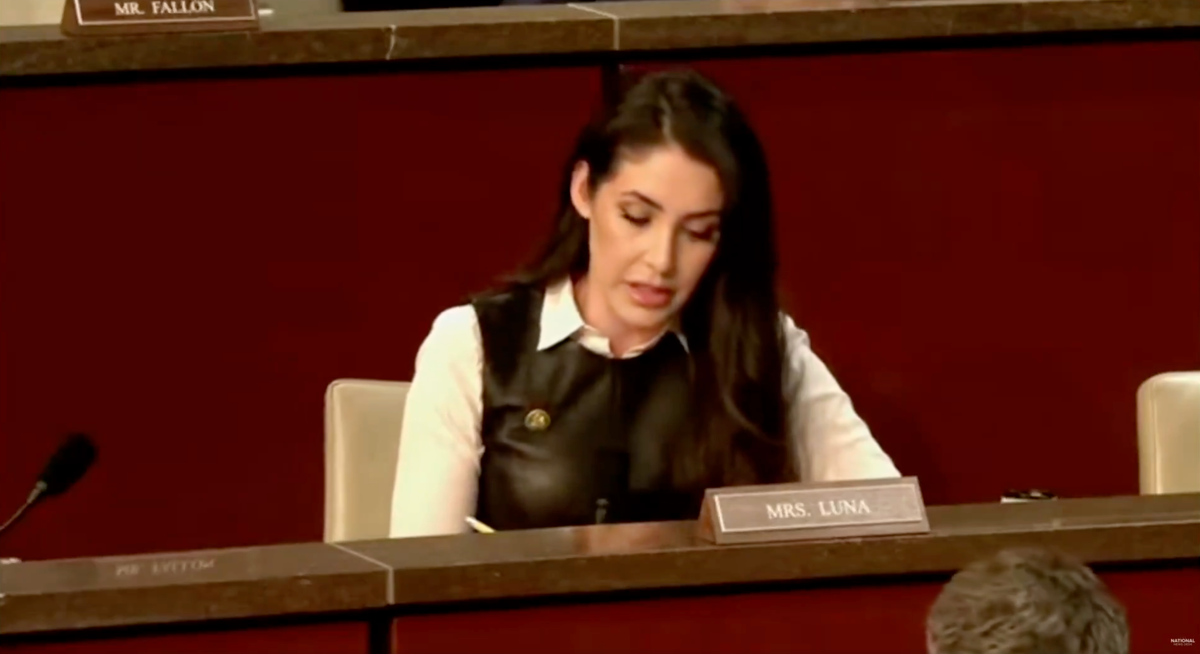
The House Committee on Oversight and Reform subpoenaed journalist Seth Harp to testify before Congress after he identified a Delta Force commander, who he said was involved in the United States military operation that kidnapped Venezuela President Nicolás Maduro.
Republican Representative Anna Paulina Luna, who asked for the subpoena, contended that Harp “doxxed” the high-ranking officer in a post that he shared on the platform formerly known as Twitter.
Additionally, Luna accused Harp of “leaking classified information regarding the Venezuela mission, Operation Absolute Resolve” and celebrated the support from Democrats and Republicans, including Ranking Member Robert Garcia.
The subpoena was approved in a voice vote as part of a motion that included subpoenas for executors of the Jeffrey Epstein estate. Multiple representatives voted no, despite being told to support the motion by Garcia. However, it was called for the yeas.
A day later, Luna referred Harp to the Justice Department for criminal prosecution and baselessly accused him of violating the Espionage Act.
Harp is the author of “The Fort Bragg Cartel: Drug Trafficking and Murder in the Special Forces,” a book that exposed over a dozen cases of Army officers involved in drug trafficking at the base where the Green Berets, Special Forces, and Joint Special Operations Command are headquartered.
“A subpoena? Yawn,” Harp responded. “I'm an experienced federal litigator and would be happy to explain to Rep. Luna, who's not a lawyer, that civilians can't ‘leak classified intel,’ and that you can't ‘doxx’ someone by posting their own online biography.”
Harp further stated "no law protects his identity from disclosure. All I posted was his online biography, which clearly identifies him as an elite U.S. Army Special Forces officer. If Delta Force didn't want his identity to become known, then they shouldn't have put his bio up on a website.
"The fact that I have not suffered any legal repercussions demonstrates that what I did was perfectly legal and appropriate," Harp declared. "I'm an investigative reporter; it's not my job to keep secrets for the government or to censor myself for the convenience of high-ranking officials. Nor would I have deleted what I posted except that X locked my account and forced me to delete it in order to log back in."
The Freedom of the Press Foundation (FPF), Defending Rights and Dissent (DRAD), and Florida’s First Amendment Foundation condemned the subpoena.
“Journalists don’t work for the government and can’t ‘leak’ government information,” Seth Stern, the advocacy director for DRAD insisted. “[T]o the contrary, it’s their job to find and publish the news, whether the government wants it made public or not. Identifying government officials by name is not doxxing or harassment, no matter how many times Trump allies say otherwise.”
Stern recalled, “In 2024, the House unanimously passed the PRESS Act to protect journalists from subpoenas about their newsgathering. The bill died after Trump ordered the Senate to kill it on Truth Social. Apparently, so did the principles of Reps. Luna, Garcia and their colleagues.”
Chip Gibbons, policy director for DRAD, said Luna’s subpoena against a reporter was “clearly designed to chill and intimidate a journalist doing some of the most significant investigative reporting on U.S. Special Forces.”
“Her own statement makes clear that far from having a valid legislative purpose, she seeks to hold a journalist ‘accountable’ for what is essentially reporting she dislikes. Her rationale is based on easily debunkable disinformation,” Gibbons added.
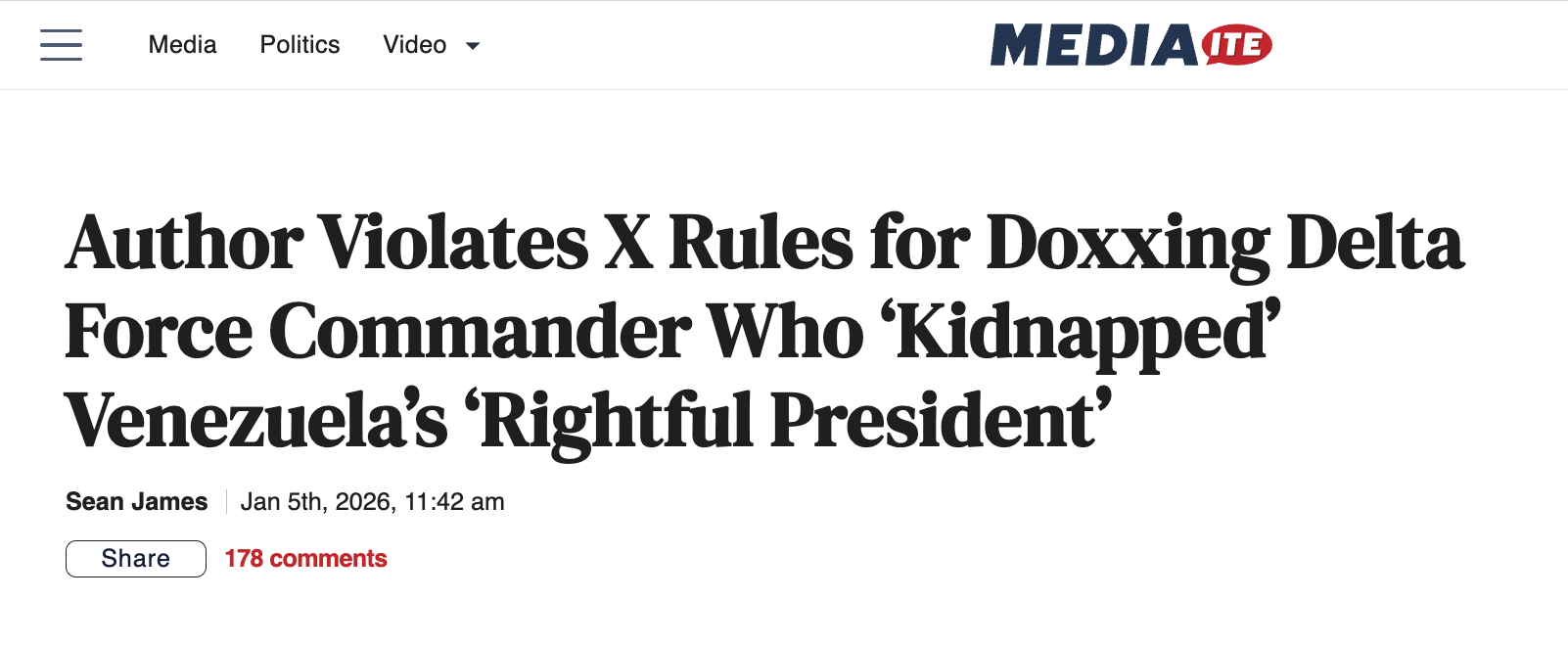
Indeed, Luna shared a screen shot of a Mediaite post with a clickbait headline that laundered this “easily debunkable disinformation.”
What Harp initially shared was the commander’s name and a publicly available online biography. He wrote, “This is the current commander of Delta Force, whose men just invaded as sovereign country, killed a bunch of innocent people, and kidnapped the rightful president.”
Part of the objection undoubtedly stemmed from the fact that the commander was not identified to praise him but rather to condemn his alleged role in the operation. (For example, in 2012, an anonymous Navy SEAL wrote a book on the raid that killed Osama bin Laden. Their identity was quickly revealed by Fox News, however, no member of Congress ever subpoenaed anyone at Fox News.)
Soldier of Fortune, which was founded by former Green Beret Robert K. Brown in 1975, published an editorial by the magazine’s current owner Susan Katz Keating.
Keating, a former senior editor for defense, justice, and international relations at the conservative Washington Examiner, scolded Harp. “Soldier of Fortune never has argued that military operations should be immune from scrutiny. But there is a difference between analyzing a mission and exposing the identity of an elite operator.”
“The former is journalism. The latter departs from long-established standards of professional restraint. In national security, the consequences of that exposure do not disappear when a post is deleted,” Keating argued.
In a comment that Soldier of Fortune included from Harp, he asserted, “In no way did I ‘doxx’ the officer. I did not post any personally identifying information about him, such as his birthday, social security number, home address, phone number, email address, the names of his family members, or pictures of his house. What I posted is still online on Duke University’s website for all the world to see.”
Nonetheless, there was a backlash that was broadly spurred by conservative media influencers, which led “X admins” to lock Harp’s account. To regain access to his account, he had to delete several posts.
The social media platform made him remove the online biography that he posted of the Delta Force commander, “a full-bird colonel, whose identity is not classified and which anyone skilled” at the Freedom of Information Act (FOIA) could find out.
Harp had posted the “records of deceased special operators” as well. These were “obtained through FOIA,” “specifically said “‘Delta Force’ on them,” and had no redactions. “In the spirit of fairness, I also posted my own service record. X required me to delete those posts, too.”
Bobby Block, executive director of Florida’s First Amendment Foundation, maintained, “This is a naked attempt to intimidate a journalist for doing his job. Rep. Luna’s own words make clear this subpoena has no legitimate legislative purpose — it’s about punishing reporting she doesn’t like. That kind of abuse of power strikes at the heart of the First Amendment and threatens the public’s right to know.”
Again, a bipartisan group in Congress probably would not have subpoenaed Harp reporter if he had openly supported the military incursion. Yet Harp did not mince words when expressing his viewpoint.
Delta Force, acting on President Trump’s unlawful orders, which contravened every principle of international law and sovereignty, as well as the Congress’s prerogative to declare war, invaded Venezuela, killed scores of Venezuelans who posed no threat to the United States, and kidnapped the Venezuelan president, Nicolas Maduro, as well as his wife.”
Every civilian official and military officer in the American chain of command who participated in this outrageously illegal and provocative act of war—which a supermajority of Americans oppose—is the legitimate subject of journalistic scrutiny, and X has no business censoring my timely and accurate reporting.
It is worth recalling that frequently U.S. officials and even members of the press accused WikiLeaks founder Julian Assange of “leaking” information, despite the fact that Assange never had access to government databases.
By conflating sources and journalists, like in the Assange case, officials like Luna make it easier for the government to pursue repressive actions that infringe upon freedom of the press.
Comments ()