
A Tribute To CIA Whistleblower John Stockwell
When former CIA officer John Stockwell came forward, he maintained that he was the highest ranking officer to go public and tell the truth about the agency.
When former CIA officer John Stockwell came forward, he maintained that he was the highest-ranking officer to go public and tell the truth about the agency.
He authored a memoir, “In Search of Enemies: A CIA Story,” that further exposed the cult of intelligence in the United States. The CIA retaliated by suing Stockwell for violating his “secrecy agreement” and secured a settlement, where all book royalties would be paid to the United States government.
Stockwell worked for the CIA for 12 years. During part of that time, he was the station chief for the CIA’s covert operations in Angola. He recalled, “Under the leadership of the CIA director we lied to Congress and to the 40 Committee, which supervised the CIA’s Angola program. We entered into joint activities with South Africa.” (South Africa was an apartheid state.)
“And we actively propagandized the American public, with cruel results—Americans, misguided by our agents’ propaganda, went to fight in Angola in suicidal circumstances. One died, leaving a widow and four children behind,” Stockwell added. “Our secrecy was designed to keep the American public and press from knowing what we were doing—we fully expected an outcry should they find us out.”
On June 14, Stockwell died at the age of 88. He went missing, and police later found his body in a “wooded area” not far from his home in Austin, Texas.
The New York Times’ obituary mentioned that Stockwell’s family moved to the Democratic Republic of the Congo in the 1940s after his father was “contracted to build a hydroelectric plant for a Presbyterian mission. At a boarding school that his mother supervised, his classmates were from the country, and when revelations about the CIA’s plot to poison Prime Minister Patrice Lumumba became public, it deeply affected him.
“First, men I had worked with had been involved,” Stockwell shared. “Beyond that, Lumumba had been baptized into the Methodist Church in 1937, the same year I was baptized a Presbyterian.” Lumumba and Stockwell were part of overlapping church communities, and the future prime minister was a “member of the missionary community” where he grew up.
A resignation letter to CIA Director Stansfield Turner, published by the Washington Post in 1977, specifically described how he became disillusioned with the CIA while stationed in Angola.
“From a chess player’s point of view the intervention was a blunder. In July 1975, the MPLA was clearly winning, already controlling 12 of the 15 provinces, and was thought by several responsible American officials and senators to be the best-qualified to run Angola; nor was it hostile to the United States,” according to Stockwell. “The CIA committed $31 million to opposing the MPLA victory, but six months later, the MPLA had nevertheless decisively won.”
“[T]he United States was solidly discredited, having been exposed for covert military intervention in African affairs, having allied itself with South Africa, and having lost.”
Stockwell additionally contended that when he was recruited in 1964 it was emphasized that the CIA was “high-minded and scrupulously kept itself clean of truly dirty skullduggery such as killings and coups, etc.” Yet the CIA was involved in assassinations of Latin American politicians and engaged in a coverup of the agency’s involvement in the assassination of Lumumba.
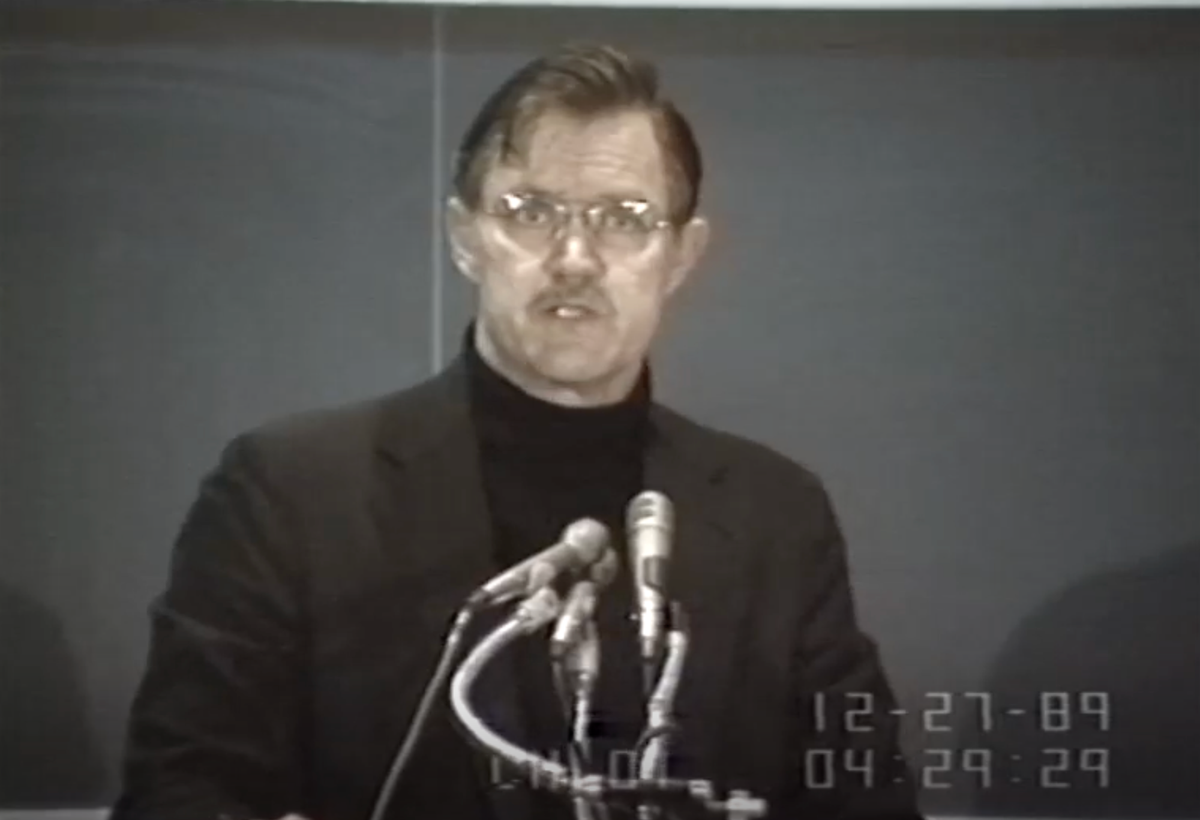
Throughout the late 1970s and 1980s, including when President Ronald Reagan’s administration was embroiled in the Iran-Contra scandal, Stockwell gave numerous interviews and delivered many lectures. (Here is a video of Stockwell at American University in 1989, when he talked for nearly three hours about the “secret wars of the CIA.”)
Stockwell said in a 1985 interview that he went into the CIA thinking that he was doing the “best thing” that he could do with his life, “the contradiction being that I was a humanist at heart. But, of course, their propaganda line is that you’re serving humanity by struggling to keep the world free from communism. It just took a lot of years making my way up the chain of command until I became convinced just the opposite was true.”
From his time on a National Security Council subcommittee that managed covert action in Angola, he insisted that in “meeting after meeting, 170 meetings,” all he heard were discussions about “what lies to tell the American people, what lies to tell the Congress, what lies to tell each other, and never, ever any conception of telling the truth.”
By his estimation, during the time that he was in the CIA, anywhere from three to six million people died as a result of covert operations and the agency’s role in wars in Vietnam and Cambodia.
Stockwell mentioned in his memoir that he “testified for five days to Senate committees,” giving them full details about agency activities before writing “In Search of Enemies.”
“Unfortunately,” as he observed, the “intelligence committees in Washington are unable to dominate and discipline the agency. Some senators even seem dedicated to covering up its abuses.” He concluded that “only an American public can bring effective pressure to bear on the CIA.”
Part of Stockwell’s resignation letter to Turner took a stand for freedom of expression amidst the CIA director’s push to criminalize any disclosure of information. He argued that if this happened then “Americans who work for the CIA could not, when they find themselves embroiled in criminal and immoral activity which is commonplace in the Agency, expose that activity without risking jail or poverty as punishment for speaking out.”
“Cynical men, such as those who gravitate to the top of the CIA, could then by classifying a document or two protect and cover up illegal actions with relative impunity,” Stockwell declared.
Sadly, in the past twenty years, this is the status quo that developed at the CIA, and more broadly, the national security state. Former CIA officers like John Kiriakou and Jeffrey Sterling came forward to criticize the CIA. They were then prosecuted under the Espionage Act and sentenced to prison after the Justice Department secured convictions.
The CIA did not have to prosecute Stockwell. There was no internet, and precedents in two cases were effective enough in establishing a prepublication review system that empowered the agency to suppress books detailing corrupt, criminal, or shameful acts.
Former CIA employee Victor Marchetti co-authored a 1974 book, “The CIA and the Cult of Intelligence,” that described the CIA as a “secret fraternity of the American political aristocracy.” The agency went to court and secured a decision that allowed the government to enforce secrecy agreements against intelligence employees. The book was published with text that indicated where lines were exactly deleted.
After former CIA officer Frank Snepp authored “Decent Interval” in 1977 about the CIA’s role in the fall of Saigon, the CIA sued Snepp. The American Civil Liberties Union, the National Lawyers Guild, and other groups argued that the precedent was an “intolerable restraint on the First Amendment right to freedom of speech.” The Supreme Court later ruled that the agency not only had the authority to censor Snepp but they could also collect the royalties from Snepp’s book, too.
Stockwell grew disillusioned with the CIA during a time that the agency had hundreds of journalists on the payroll. He recognized that it was unusual for the Washington Post, the New York Times, and Mike Wallace and “60 Minutes” to be interested in his story.
“Three Days of the Condor” (1975) had Robert Redford walk into the New York Times with his story. That’s the way the movie ended, but of course, by and large if you walk into the New York Times with a story like that, they’ll throw you out,” Stockwell contended. “[T]he simple truth, the unending and continuing horror of what the CIA is doing, they don’t publish it.”
Stockwell saw his book as a way to reclaim his First Amendment right to freedom of speech, which did not exclude Americans who “signed CIA oaths.” And as he eloquently declared in his resignation letter to the CIA director, “I predict that the American people will never surrender to you the right of any individual to stand in public and say whatever is in his heart and mind.”
“That right is our last line of defense against the tyrannies and invasions of privacy which events of recent years have demonstrated are more than paranoiac fantasies.”
Comments ()